For Ersi Retounioti, the Summer School meant venturing beyond familiar territory. With a background in biomedicine and disease modelling, she joined the Pinheiro lab at the IMP to explore how the physical properties of tissue help shape a developing zebrafish embryo. Ersi spoke to us about adapting to the rhythms of a living model organism, approaching biology through the lens of physics, and discovering a research community built on collaboration.
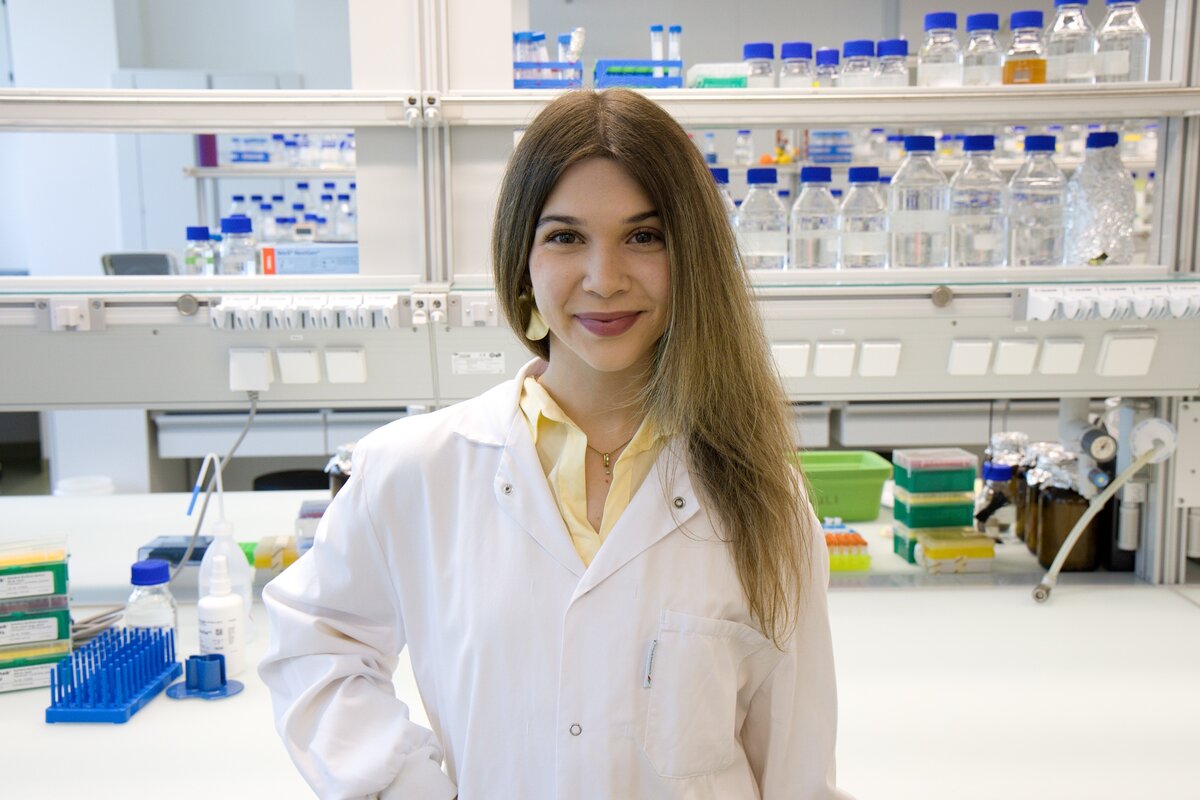
Can you tell us a little about your background?
My name is Effrosyni Retounioti but everyone calls me Ersi. I am originally from Athens, Greece, and moved to the Netherlands at the age of 17 to study Biomedical Sciences at Maastricht University. I am currently pursuing a master’s degree in Cancer, Stem Cells and Developmental Biology at Utrecht University.
During my master’s programme internship, I am working with kidney organoids to model cystinosis, a rare genetic disease for which there is still need for curative treatment.
How did you hear about the Vienna BioCenter Summer School, and why did you apply?
The coordinator of my master’s programme introduced the Summer School to our cohort. There are the many scientific connections between research institutes in Vienna and the Netherlands, and because of this, he encouraged us to apply.
I was immediately excited, because the programme offered an opportunity to pursue something quite different from my previous research. I had worked mainly on disease modelling and cell-based systems, and I wanted to explore a new field and a different way of thinking about biology.
What did you work on for your Summer School project?
I joined the Pinheiro lab, where researchers use zebrafish and human embryonic stem cells to study gastrulation. This is an early stage of development during which cells migrate and organize themselves to establish the basic body plan.
My project focused on the physical properties of embryonic tissue. I worked with explants—small pieces of tissue taken from zebrafish embryos—and placed them in pairs so that they could fuse. By imaging them over time, I could follow the fusion process and observe how their shape changed as they merged. We then used a theoretical model to estimate properties such as surface tension and viscosity—in other words, how strongly the tissue tries to maintain a compact shape and how easily it flows and changes form.
This was a new direction for me, as the project combined biology with concepts from physics and mathematics. Rather than focusing primarily on molecular pathways, I was investigating how physical forces influence a biological process, which I found genuinely exciting. The project left me even more invested in understanding how embryonic tissue responds to the multitude of forces acting upon it.
What did you find most exciting about the project?
The most exciting aspect was working with zebrafish, which I had never worked with before. Unlike cell cultures and organoids that I have experience with, zebrafish allowed me to observe development as it unfolded.
I also appreciated the exploratory nature of the project. My previous work was closely tied to disease modelling, but this project centred on observing the embryos, troubleshooting, and trying to understand what the tissue was doing. It offered me a very different perspective on how biological questions can be approached.
Did anything unexpected happen?
The biggest challenge for me was initially adapting to the technical work: injecting, dechorionating, and sectioning the zebrafish embryos. Each of these required precision and practice.
Another challenging aspect was adapting to the requirements and rhythms of a living organism. With cell lines, I could usually plan my experiments several weeks in advance and rely on having the necessary material available. But zebrafish follow their own rhythm. We would prepare everything the day before and work according to their light-dark cycle, yet on some mornings the fish laid fewer eggs than we needed, which required us to adapt as we went. When working with an animal, you do not have full control. I had to learn to be considerably more flexible and to prepare several backup plans.
What was your favourite aspect of the Summer School?
Working with supervisors at different career stages was a very valuable part of the experience. Sarah Jay and Guilherme Bastos Ventura, with guidance from our group leader Diana Pinheiro all brought a different perspective. From the outset, I felt comfortable asking questions, even though I did not have an extensive background in developmental biology. What mattered was being curious, adaptable, willing to learn.
Equally rewarding was the community of fellow Summer School participants. Sharing our projects, challenges and progress with peers working in different labs across the campus broadened my perspective. The community made the experience a lot more enjoyable.
What stood out to you about doing research at the Vienna BioCenter?
What struck me most was how little distance there seemed to be between having an idea and being able to test it. The facilities, technology, and expertise available across the Vienna BioCenter made it possible to address questions remarkably quickly.
The BioOptics facility, for example, helped us establish an imaging pipeline for the project. We could place the explant pairs in a 96-well plate, load it into an automated confocal microscope, and leave it to image them overnight. By the following morning, we had detailed three-dimensional images ready for analysis.
More broadly, people were very willing to help one another. Whenever I needed a particular material or some advice, I could reach out to the wider scientific community on campus and often find support within hours. This made science feel truly collaborative, rather than a challenge that each researcher had to face alone.
Has the experience changed how you think about your future?
The experience showed me how exciting research can be. It also encouraged me to explore scientific questions beyond the areas I was already familiar with. Coming from biomedicine, I had not expected to find myself working with zebrafish and applying physical and mathematical concepts to embryonic development, but I thoroughly enjoyed that shift.
After completing my master’s degree, I would like to take some time to travel and volunteer abroad, particularly in areas such as education, children’s advocacy, women’s rights, or the environment. I will then consider whether pursuing a PhD is the right next step for me. The question remains open, but the Summer School has given me a broader sense of the kinds of research and working environments that are possible.
Interview conducted in August 2026.
Further reading