A summer at the Vienna BioCenter can be a real turning point for young scientists. We spoke with a Master’s student from the Philippines, Aleq Adrianne, who joined the Pauli lab for the Vienna BioCenter Summer School to explore zebrafish fertilisation assays and advanced proteomics techniques.
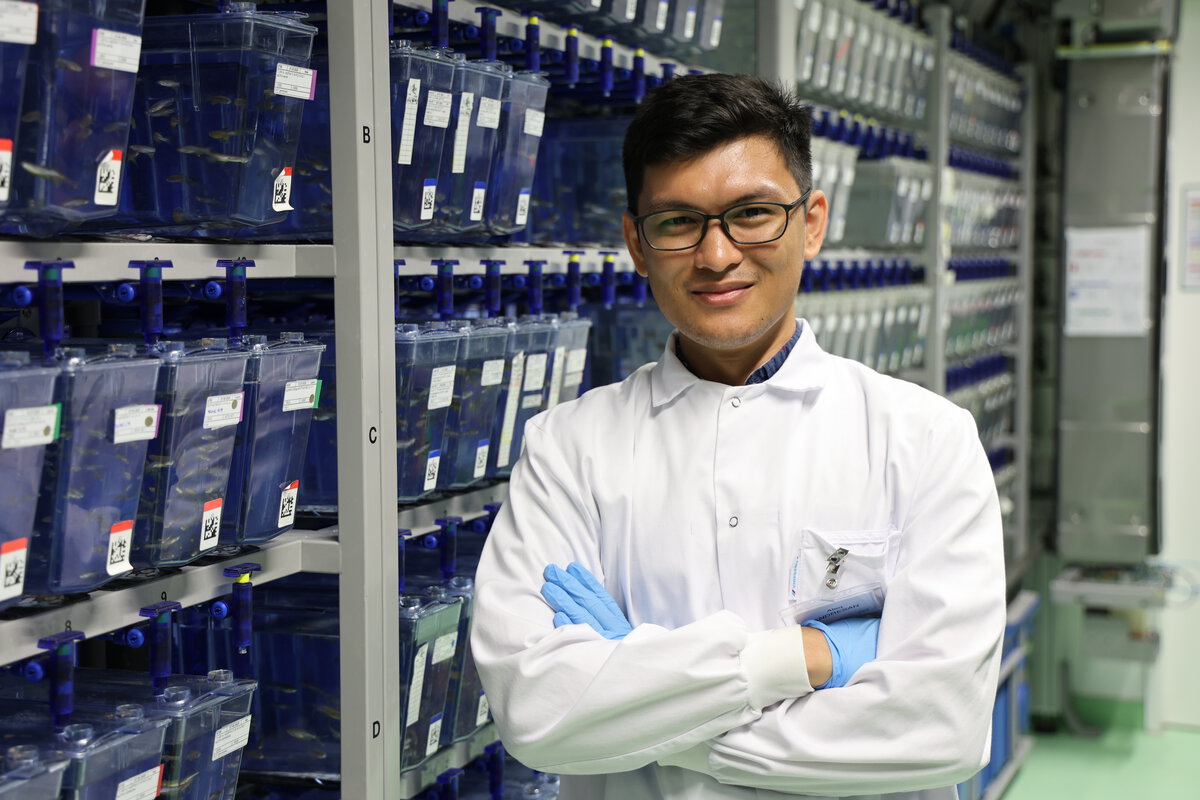
Can you tell us a bit about your background—your studies and lab experience before joining the Pauli lab for the summer school?
I was a Master’s student at the National Institute of Molecular Biology and Biotechnology (NIMBB) in the Philippines. Most of my lab work before the summer school focused on fundamental molecular biology and cell culture techniques, on things like cloning, cell line maintenance, transfection, and qPCR. I learned these during my undergraduate degree and through my work as a research assistant at NIMBB. I also picked up basic bioinformatics skills as part of my undergraduate thesis and expanded on that later during a short stint at the Philippine Genome Center.
How did you first find out about the Vienna BioCenter Summer School?
My supervisor encouraged me to apply after hearing about the program from one of his former students, who’s now doing a PhD at the Vienna BioCenter. That personal connection made the opportunity feel both real and exciting.
What's your experience as a Summer School student, and what are you working on in the lab?
My summer school project is quite different from my work back at home. There I studied epigenetic gene regulation which involved a lot of RNA work. In the Pauli lab, I am working in vivo with zebrafish in fertilization assays and in vitro with sperm samples to isolate protein samples. It's quite an exciting leap from the RNA world to the protein world, and I'm able to do things like Co-Immunoprecipitation/Mass Spectrometry that would be difficult to set up back at home.
What’s your favourite part of the Summer School program and why?
My project here is quite different from what I’ve been doing in the Philippines. Back home, I studied epigenetic gene regulation, which meant a lot of RNA work. In the Pauli lab, I’m working both in vivo with zebrafish during fertilisation assays and in vitro with sperm samples to isolate proteins. It’s been an exciting leap from the RNA world to the protein world. One of the biggest differences is access to techniques like co-immunoprecipitation and mass spectrometry, methods that would be very difficult to set up in my lab at home. Here, I’ve been able to actually do them hands-on.
What stood out to you most about doing research at the Vienna BioCenter?
What really impressed me is how the Vienna BioCenter gives us everything we need to take our projects to the next level. The molecular biology facility provides every enzyme and strain imaginable, the proteomics facility can do incredible things with your samples, and the imaging facility has the expertise to help visualise complex biological processes. It opened my eyes to what’s possible when science is fully supported. But it’s not just the science. The social aspect of the program is just as special. I’ve made great friends in my lab and among my cohort, and met scientists from all over the world who are as passionate about biology as I am. I’ve also had the chance to talk to leaders in the field. That sense of community is something I’ll carry with me.
What’s next for you after the summer school?
I’ll be finishing my Master’s degree back home, bringing with me everything I’ve learned here, not just the technical skills but also the kindness and support I’ve received. My hope is to return to the Vienna BioCenter as a PhD student in the future and pay forward the opportunity that was given to me.
Interview conducted in August 2025.
Further reading