For nearly four decades, Sanger sequencing has been a fixture of research at the IMP. Since the institute's earliest days, scientists have relied on the technology to verify DNA constructs, identify mutations, and answer countless biological questions. Over the years, the service evolved from a painstaking manual process involving radioactive labels and hand-read sequencing gels into a highly automated operation capable of processing hundreds of thousands of samples each year.
Now, as the IMP transitions from operating the Sanger sequencing service in-house to working with an external provider, the moment offers an opportunity to reflect on the technology's remarkable journey and its role in supporting generations of researchers.
To look back on nearly forty years of sequencing at the IMP, we spoke with Robert Kurzbauer, who helped establish the service in the institute's early years; Markus Hohl, sequencing specialist at the Molecular Biology Service (MBS); and Harald Scheuch, Head of MBS.
“Everything was done manually.”
When the IMP opened its doors in 1988, DNA sequencing looked very different from today.
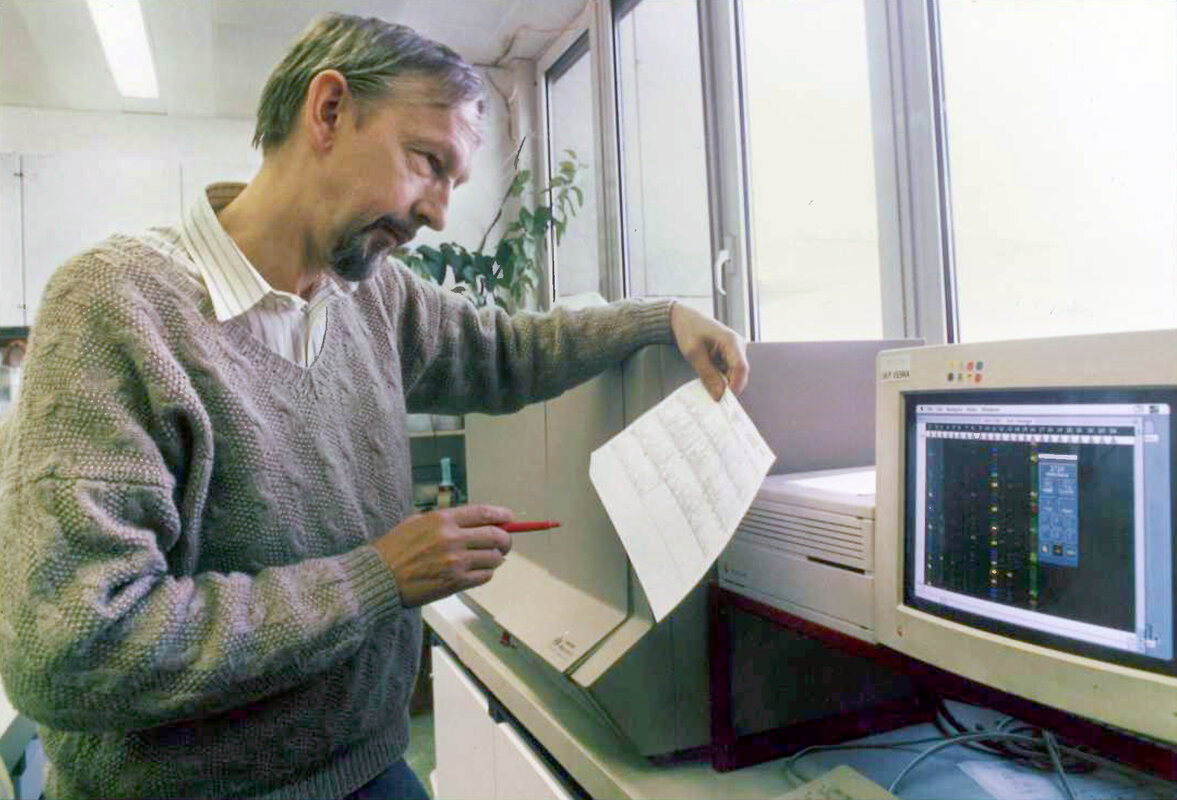
Robert Kurzbauer joined the institute in December 1987 and soon became involved in establishing Sanger sequencing as a scientific service. At the time, sequencing was still performed using radioactive labels, large polyacrylamide gels, photographic films, and a considerable amount of patience.
"The first three years were with radioactive labels, and everything was done more or less manually," recalls Kurzbauer.
Each DNA sample required four separate sequencing reactions—one for each nucleotide—and each reaction had to be loaded onto large sequencing gels by hand. After electrophoresis, the gels were fixed, dried, exposed to film, and developed overnight.
The resulting band patterns were then interpreted manually. There were no colourful chromatograms, no automated base calling, and no user-friendly software.
"It needed a lot of expertise to analyse the data," says Kurzbauer. “You had to look at the bands and decide which nucleotide was present. Very often, I would go through the data together with the scientists.”
The process was not only labour-intensive but also involved daily exposure to radioactive materials.
"For three years, I was working with hot radioactivity every day," he remembers. “Everything was open. We handled the radioactive samples for hours.”
Despite the effort involved, the service quickly became an essential part of the institute's research infrastructure.
The automation revolution
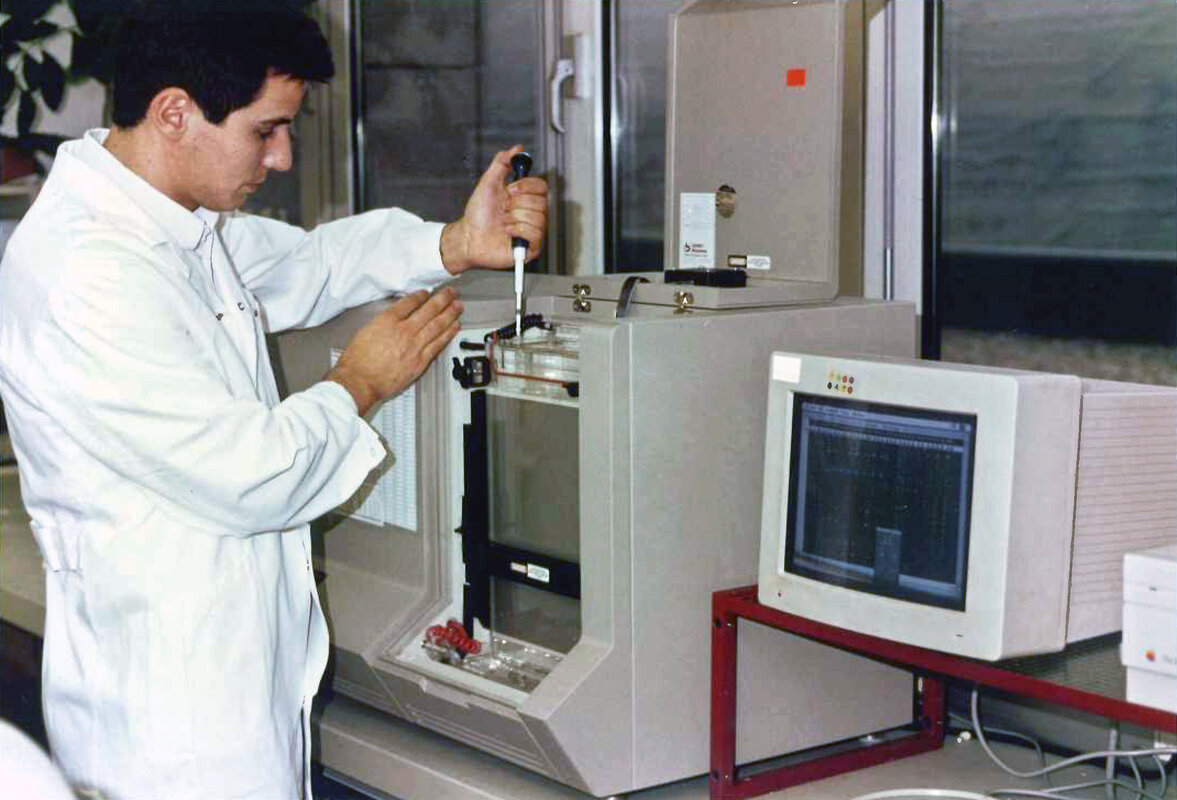
The first major transformation came in 1991, when the IMP acquired its first automated DNA sequencer. Instead of radioactive labels, the new instruments used fluorescent dyes, allowing all four sequencing reactions to be analysed in a single lane and detected automatically.
"Life became much easier," says Kurzbauer. "And much less dangerous."
Over the following decade, sequencing technology advanced rapidly. Markus Hohl arrived at the IMP in 1999, at a moment when the service was beginning to scale up. Around 10,000 sequencing reactions were already being processed each year, but many parts of the workflow still required considerable manual work. The automation that would transform the service was only just beginning to take hold.
Over the following years, new sequencing platforms, robotic sample handling, and automated data analysis steadily increased capacity while reducing turnaround times.
"About three to three and a half hours after a person submits samples, they can already have sequencing results," says Hohl. The contrast with the early years could hardly be greater. What once required days of hands-on work—from preparing gels to interpreting results manually—can now be completed largely automatically.
Samples submitted by users on a Friday afternoon can be processed over the weekend, with results analysed, uploaded, and delivered to scientists without human intervention. As sequencing became faster and more accessible, demand grew dramatically. According to Harald Scheuch, Head of the Molecular Biology Service, the service reached its peak around 2012–2013, processing approximately 220,000 samples per year.
Even in recent years, annual numbers remained around 150,000 samples. "The turnaround time is essentially overnight," says Scheuch. "For many users, results are already available the next morning."
Contributing to major scientific milestones
Over the years, the IMP's sequencing service supported countless research projects. One milestone was the institute's contribution to the Human Genome Project, the international effort that produced the first complete sequence of the human genome.
"Many laboratories around the world worked together on this project," says Scheuch.
At the time, Sanger sequencing was the only technology capable of generating the required data. Because each sequencing reaction produced only a few hundred to a thousand DNA bases, the project required enormous international collaboration.
"It took more than a decade to complete," says Kurzbauer. "The Human Genome Project started in 1990 and was finished in 2003."Today, the same amount of genomic information can be generated in hours using next-generation sequencing technologies.
Another project that stands out for Kurzbauer was the sequencing of the CELO virus (Chicken Embryo Lethal Orphan virus, an avian adenovirus) genome in 1994, conducted together with colleagues Matt Cotton and Susana Chiocca. "It was the first whole-genome sequencing project performed in-house at the IMP," he says “it was really exciting to be part of it”.
The project eventually resulted in a patent and contributed to the development of a viral transfection system. Although sequencing the genome itself took roughly a year, much of the effort went into fragmenting the viral DNA, cloning it into smaller pieces, and assembling the sequence without the benefit of today's molecular biology kits and computational tools.
The service evolved not only technologically, but also organisationally. What began as an IMP service around 2005 became a shared resource for the Vienna BioCenter campus, supporting researchers at the Institute of Molecular Biotechnology (IMBA) and, later, the Gregor Mendel Institute of Molecular Plant Biology (GMI) alongside the IMP.
These developments reflect just how profoundly both the service and the field changed over the course of nearly four decades.
"Almost none of the techniques we take for granted today existed at that time," Kurzbauer recalls.
For him, some of the most memorable moments are not tied to specific projects but to the people involved. Looking back on the IMP's early years, he remembers sitting side by side with young scientists who would later become internationally renowned researchers.
"I was going through sequencing data together with Angelika Amon, Meinrad Busslinger, Giulio Superti Furga and Kim Nasmyth," he says. "At the time, we were just working together. Looking back now and seeing the careers they went on to have, it was really special."
The end of an era, not the end of the service
The service will continue through an external provider, ensuring that researchers retain access to a technology that remains a cornerstone of molecular biology. Yet for the scientists and service staff who built and sustained the sequencing operation over nearly four decades, the transition marks the close of a remarkable chapter.
From manually reading radioactive sequencing gels to automated systems processing hundreds of thousands of samples each year, the history of Sanger sequencing at the IMP mirrors the broader transformation of molecular biology itself.
Few technologies have shaped modern life science as profoundly. And few scientific services have accompanied as many researchers, projects, and discoveries throughout the history of the institute.