Putting the brakes on the genome’s folding motor
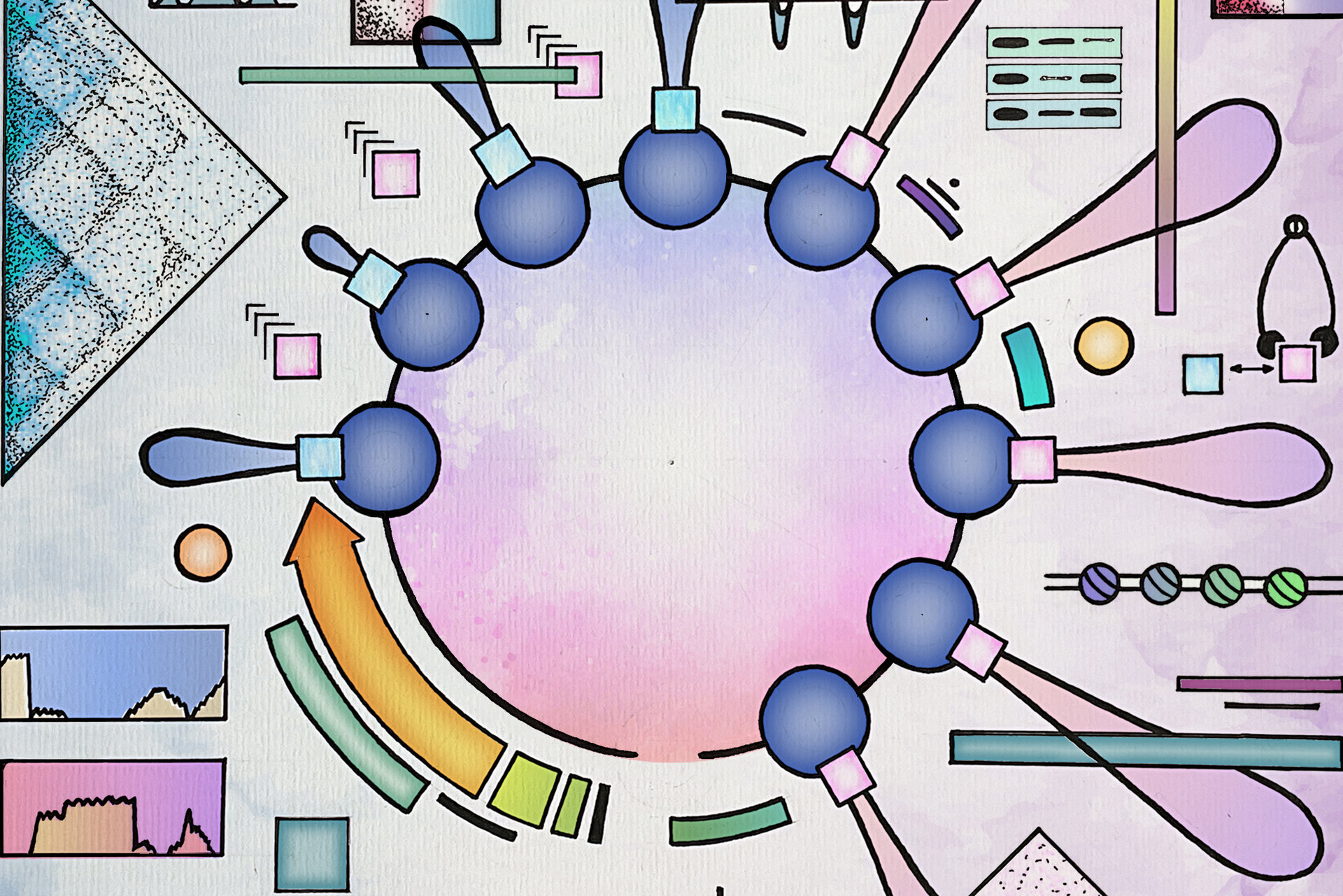
Inside the cell nucleus, two meters of DNA strand are folded into a highly organised structure by cohesin, a protein complex that shapes and regulates the genome by forming DNA loops. To function properly, this loop-building activity must be precisely controlled. Scientists in the lab of IMP Scientific Director Jan-Michael Peters have now discovered how cells put brakes on this process. Their findings, which reveal a key mechanism of genome organisation, were now published in the journal Molecular Cell.
DNA is a long thread that carries genetic information—if stretched out, human DNA of each cell would measure about two meters. Rather than lying loose, this thread is folded into a complex three-dimensional structure. This shape controls how genes are activated, repaired, or recombined.
At the heart of the organisation machinery is cohesin, a ring-shaped protein complex that extrudes DNA into loops—bringing distant regions into contact and thereby shaping the genome’s three-dimensional architecture. Without control, this looping activity could quickly become disordered. Specialised boundary elements therefore act as safeguards: DNA binding proteins such as CTCF ensure that loops form in the right places and that genes connect with the correct regulatory elements.
This dynamic folding process guided by cohesin is essential for development, gene regulation, and gene recombination, and its disruption is linked to diseases.
But how cells control growing of DNA loops and when this growth stops was poorly understood. Key suspects behind these processes were the PDS5 proteins—known to interact with cohesin and required for proper genome organisation. Previous studies had shown that without PDS5, the boundaries that normally organise the genome begin to break down. Yet despite this crucial role, how PDS5 proteins influence loop formation—and how they control cohesin’s activity—remained a mystery.
Researchers from the lab of Jan-Michael Peters at the IMP, together with international collaborators, have now discovered that PDS5 proteins act as key regulators of genome architecture by controlling how long the loop-forming machinery stays active. By combining single-molecule imaging, genomic approaches, and computational modelling, the team shows how PDS5 proteins stop loop extrusion at the right time, ensuring proper genome folding.
How cells control the timing of genome folding
To find out how cells stop DNA loops from growing, the researchers combined approaches that capture genome organisation at different levels. Using single-molecule imaging, they watched individual cohesin complexes move along DNA in real time. They then examined how DNA is arranged inside living cells using genome-wide Hi-C measurements, which map which regions of the genome come into contact. Finally, computer simulations helped them understand how these molecular processes shape the overall structure of the genome.
The researchers discovered that PDS5 proteins regulate genome folding by removing NIPBL, a factor that activates loop formation, from cohesin. “PDS5 acts as a brake,” explains Gordana Wutz, Research Associate in the Peters lab and co-first author of the study. “By causing NIPBL to detach, it stops loop extrusion and limits how long cohesin can keep forming loops.”
This mechanism turned out to be critical for maintaining genome structure. By controlling how long cohesin remains active, PDS5 proteins ensure that DNA loops stop at the right positions, reinforcing boundaries formed by CTCF. Without this control, cohesin continues extruding loops for too long, weakening these boundaries and disrupting genome organisation.
The team also found that PDS5 proteins influence how the genome is partitioned into active and inactive regions, known as compartments. Their simulations show that genome organisation depends on a delicate balance between loop extrusion and the natural tendency of chromatin to separate into these compartments. By limiting both the speed and duration of loop extrusion, PDS5 proteins help maintain this balance.
“Our results show that genome folding is not just about where loops form, but also about how fast they are formed and how long they grow,” says Iain Finley Davidson, Research Associate and co-first author of the study. “PDS5 proteins play a central role in tuning these dynamics.”
These findings identify PDS5 proteins as key regulators of genome organisation and provide new insight into how DNA folding is controlled in space and time. Because genome architecture underpins processes such as gene regulation, gene recombination and DNA repair, this work advances our understanding of how cells maintain genome function.
Original publication
Gordana Wutz*, Iain F. Davidson*, Edward J. Banigan*, Roman R. Stocsits, Ryotaro Kawasumi, Wen Tang, Kota Nagasaka, Lorenzo Costantino, Ralf Jansen, Kouji Hirota, Dana Branzei, Leonid A. Mirny, Jan-Michael Peters# “PDS5 proteins control genome architecture by limiting the lifetime of cohesin-NIPBL complexes”. Molecular Cell (2026). DOI: 10.1016/j.molcel.2026.03.025
* These authors contributed equally to the study.
# Corresponding author
Further reading
Peters lab