Studying immune cell fate inside the body of mice with CRISPR
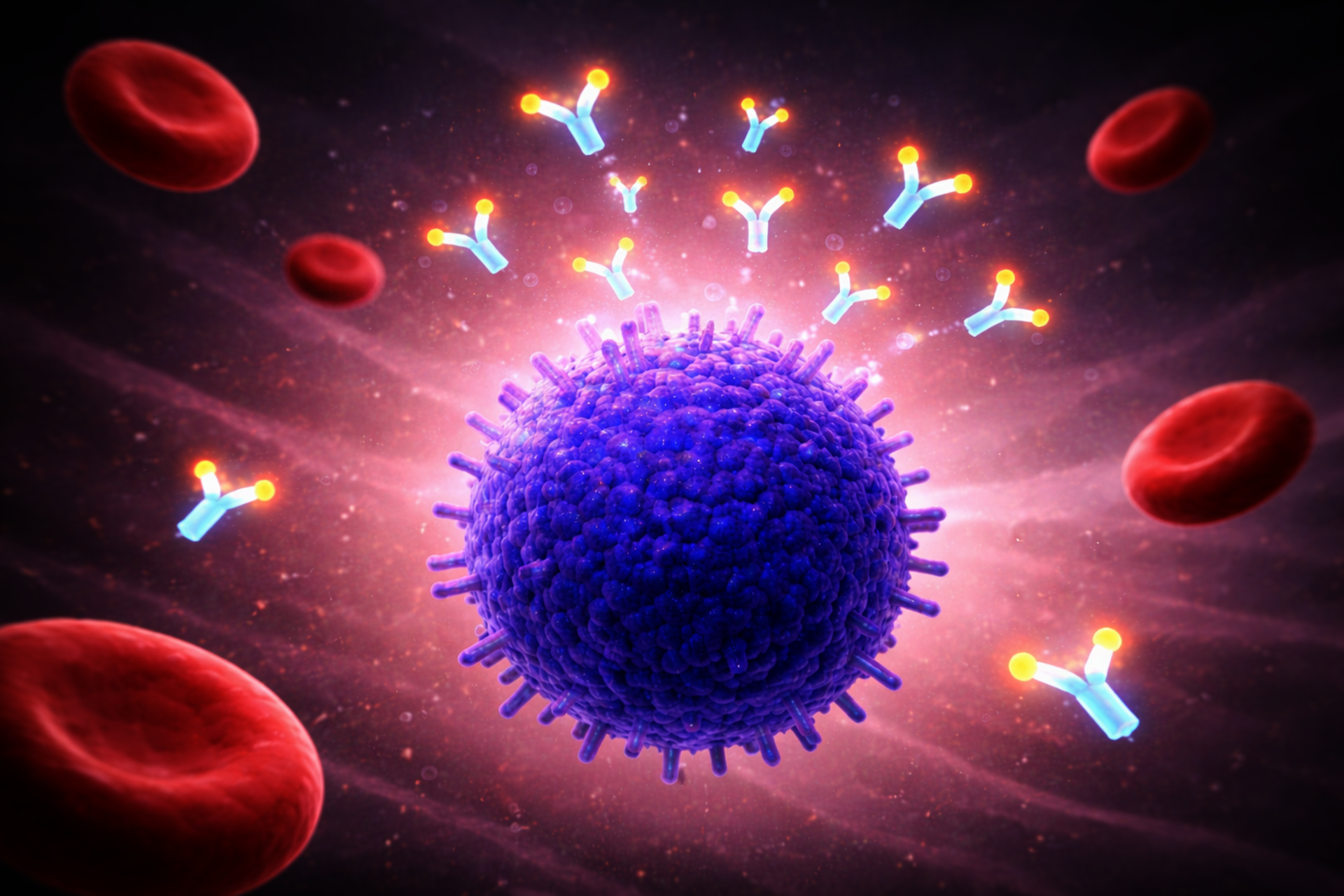
Plasma cells are the immune system’s antibody factories, but how B cells make the switch to become plasma cells has remained unclear. By developing a new in vivo CRISPR screening strategy, researchers from the lab of Meinrad Busslinger at the IMP identified dozens of previously unknown genes that drive this transition. Their findings are published in the Journal of Experimental Medicine.
When pathogens invade the body or a vaccine primes the immune system, plasma cells are rapidly mobilised to neutralise the threat. These specialised cells act as antibody factories, producing and releasing vast amounts of antibodies that bind to viruses, bacteria, and toxins, marking them for elimination. This antibody response is a central pillar of our immune defence, helping to clear infections and providing protection that can last for years.
Plasma cells originate from B cells, a type of white blood cell that circulate through the spleen and lymph nodes. When B cells encounter their specific antigen, they become activated and undergo a dramatic transformation. They change their gene expression program, remodel their internal machinery, and switch from a resting state into an antibody-secreting powerhouse.
Although plasma cells are essential for immunity, how B cells make the switch to become plasma cells—and which genes control this transition—is still not fully clear. Over the past decades, researchers have identified a small number of transcription factors that act as master regulators of plasma cell differentiation. Yet many of the players that drive this transformation remain to be discovered.
Most large-scale efforts to find new regulators have relied on experiments performed in vitro, using B cells stimulated in a dish. However, these approaches are limited because they ignore a crucial aspect of immune responses: in the body, B cells develop within a rich and dynamic microenvironment. Signals from surrounding cells and tissues strongly influence whether B cells survive, proliferate, or differentiate into plasma cells. Capturing this complexity has remained a major challenge.
Now, Lesly Calderón, a senior researcher from the lab of Meinrad Busslinger at the IMP, has collaborated with the lab of Johannes Zuber to develop a new way to systematically identify genes that regulate plasma cell formation directly inside living mice. By combining CRISPR/Cas9 gene editing with an innovative in vivo screening strategy, the team discovered dozens of previously unknown genes that control the switch from B cells to plasma cells—revealing how the immune system makes these critical cell fate decisions in its natural environment, and introducing a powerful and broadly applicable in vivo screening strategy.
A new in vivo strategy for editing immune cells
In recent years, CRISPR/Cas9— the genetic scissors that allow scientists to cut DNA at will—has revolutionised how scientists study gene function, allowing them to switch genes off with unprecedented precision. While this approach works extremely well in cells grown in a dish, translating it to living organisms has remained a major hurdle.
Delivering CRISPR components for gene editing into B cells only works efficiently once cells begin to divide. But forcing B cells to proliferate also triggers their activation and differentiation, meaning they no longer resemble the cells which initiate a natural immune response.
To overcome this obstacle, researchers in the Busslinger lab developed a new in vivo CRISPR/Cas9 screening strategy that allows B cells to be genetically modified without activating them. “For the first time, this meant that we could edit genes in B cells and then let them take part in a real immune response inside the mouse,” says Busslinger. The team achieved this by engineering a mouse model, in which mature B cells produce higher levels of a surface receptor that viral particles use to enter the cell. Normally, this receptor is present at low levels in resting B cells, making gene delivery inefficient. By increasing its availability, the researchers enabled efficient delivery of CRISPR components, without having to force the cells into premature activation.
The scientists then followed these genetically modified B cells as they took part in a normal immune response in mice, allowing them to identify genes that either promote or block the transition to plasma cells.
Using this approach, the team discovered dozens of previously unknown regulators of B cell activation and plasma cell differentiation, many of which had been missed by earlier studies performed in cell culture. “Studying immune cells in their natural environment is crucial,” says Busslinger. “Our screen revealed players that simply don’t show up when you look at cells in a dish.”
Beyond the biological insights into plasma cell differentiation, the study establishes a new powerful and versatile tool to study gene function directly in living organisms. “This approach opens the door to asking very precise functional questions in vivo,” Busslinger explains. “Whether the focus is immune regulation, infection, or even cancer-related immune responses, this method allows scientists to study gene function in conditions that closely mirror what happens inside the body.”
Original Publication
L. Calderón, M. Schäfer, M. Rončević, R. Rauschmeier, M. Jaritz, T. A. Schwickert, Q. Sun, A. Pauli, J. Zuber & M. Busslinger “In vivo CRISPR/Cas9 screens identify new regulators of B cell activation and plasma cell differentiation.” Journal of Experimental Medicine (2026). DOI: 10.1084/jem.20250594
Further reading