Separating signal from noise: How cells decide the fate of RNA
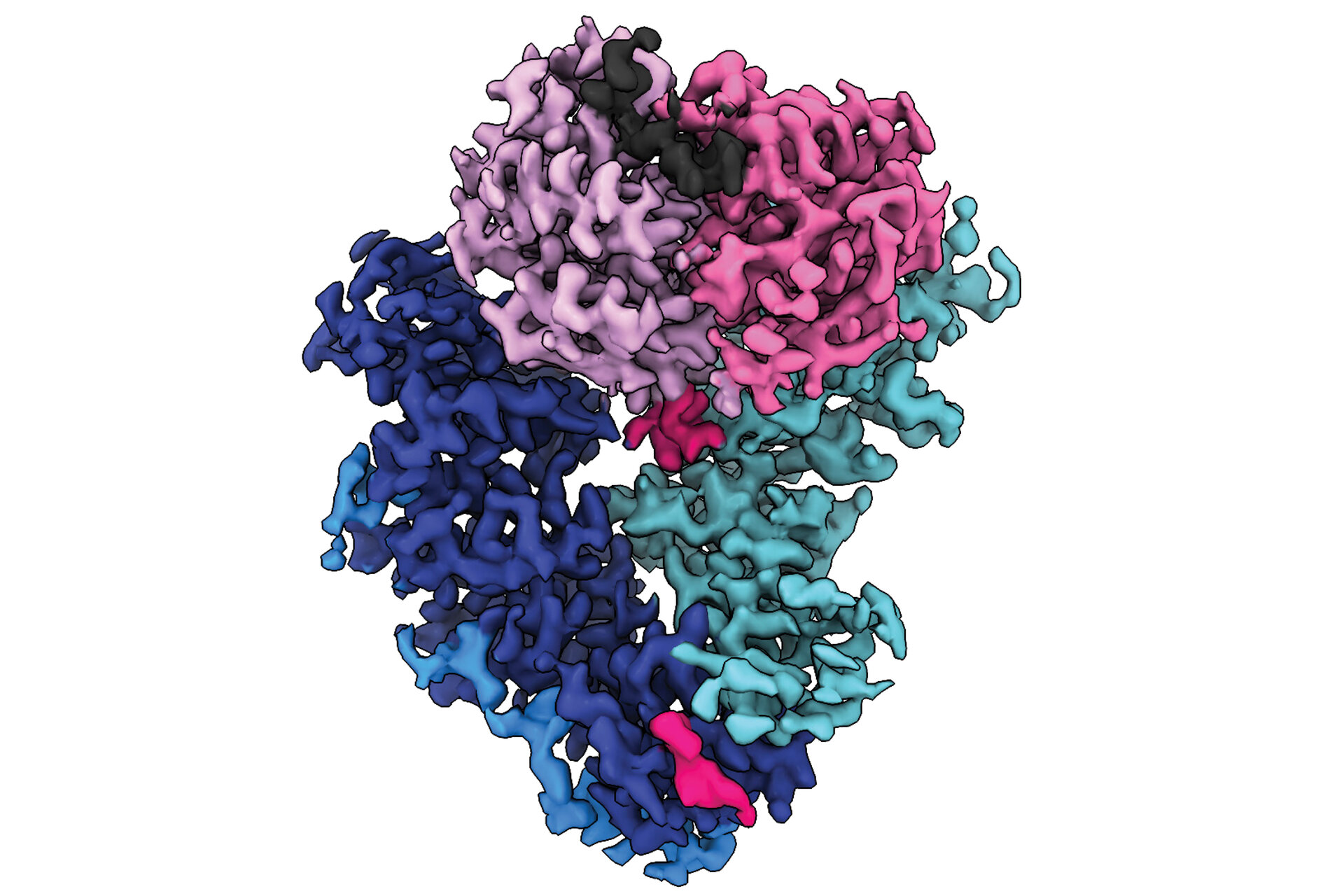
An international team of scientists including the lab of Clemens Plaschka at the IMP have discovered a fundamental mechanism that helps cells decide which RNA molecules are kept and used—and which are destroyed. Published in the journal Nature, the study reveals that RNA export and RNA decay are not separate processes, as previously thought, but two competing pathways that read the same molecular signal. The findings provide a new framework for understanding how cells maintain gene-expression fidelity.
In human cells, DNA serves as the repository of genetic information within the nucleus. DNA is continuously transcribed into mRNAs, which serve as blueprints for the building blocks of life: proteins. Remarkably, functional mRNAs are produced alongside a vast number of non-functional transcripts. While functional mRNAs are exported from the nucleus for protein production, non-functional RNAs are retained and degraded.
How cells distinguish functional RNAs from non-functional ones has remained a longstanding question in molecular biology.
For many years, the prevailing paradigm in the field has been that functional mRNAs acquire multiple maturation marks. In contrast, their non-functional counterparts were thought to fail to acquire these features and therefore become targets for nuclear degradation. However, this model could not fully explain why many proteins associated with RNA export are also found on RNAs destined for degradation.
Now, an international team of researchers from Aarhus University in Denmark and two institutes at the Vienna BioCenter in Austria—(Research Institute of Molecular Pathology IMP and Institute of Molecular Biotechnology of the Austrian Academy of Sciences IMBA)—has discovered that the pathways governing functional and non-functional RNAs are much more interconnected than previously appreciated. The work shows that both classes of RNA can acquire similar maturation marks and form seemingly functional RNA-protein complexes before ultimately being directed either toward decay or export. In an article now published in the journal Nature the scientists propose a new molecular mechanism that helps explain how cells make this fundamental decision.
The molecular race to the exit
The new model centers on a shared chemical signal: an RNA-binding protein called UAP56. Two distinct cellular complexes compete to interact with this protein: inside the nucleus, the PAXT connection reads UAP56 as a signal for RNA degradation. At the nuclear pores, where mRNAs leave the nucleus, the TREX-2 complex interprets the same signal as a cue for export.
Because both complexes recognize the same molecular marker, RNA fate becomes a question of location and timing—a "kinetic bias", or molecular race. Short, non-functional RNAs are particularly susceptible to PAXT-mediated degradation in the nuclear interior. Longer mRNAs, in contrast, are more likely to survive long enough to reach the nuclear pores, where TREX-2 promotes their export into the cytoplasm.
The findings challenge the traditional view that export and degradation pathways operate independently. Instead, they reveal a direct competition between the two systems.
A perfect match
This breakthrough emerged from an international collaboration. At the IMP and IMBA at the Vienna BioCenter, teams led by Clemens Plaschka and Julius Brennecke were studying how mRNAs are prepared for export, and had previously identified UAP56 as a key molecule orchestrating the process (link). Meanwhile in Denmark, Torben Heick Jensen’s team at the University of Aarhus was investigating how the PAXT pathway recognizes RNAs destined for decay.
By combining their expertise, the researchers discovered that a newly identified PAXT-associated protein called LENG8 performs the exact same biochemical function as TREX-2: it removes UAP56 from RNA. The critical difference is where this occurs. When TREX-2 acts at the nuclear pore, RNA export follows. When LENG8 acts as part of PAXT in the nuclear interior, the RNA is directed toward degradation.
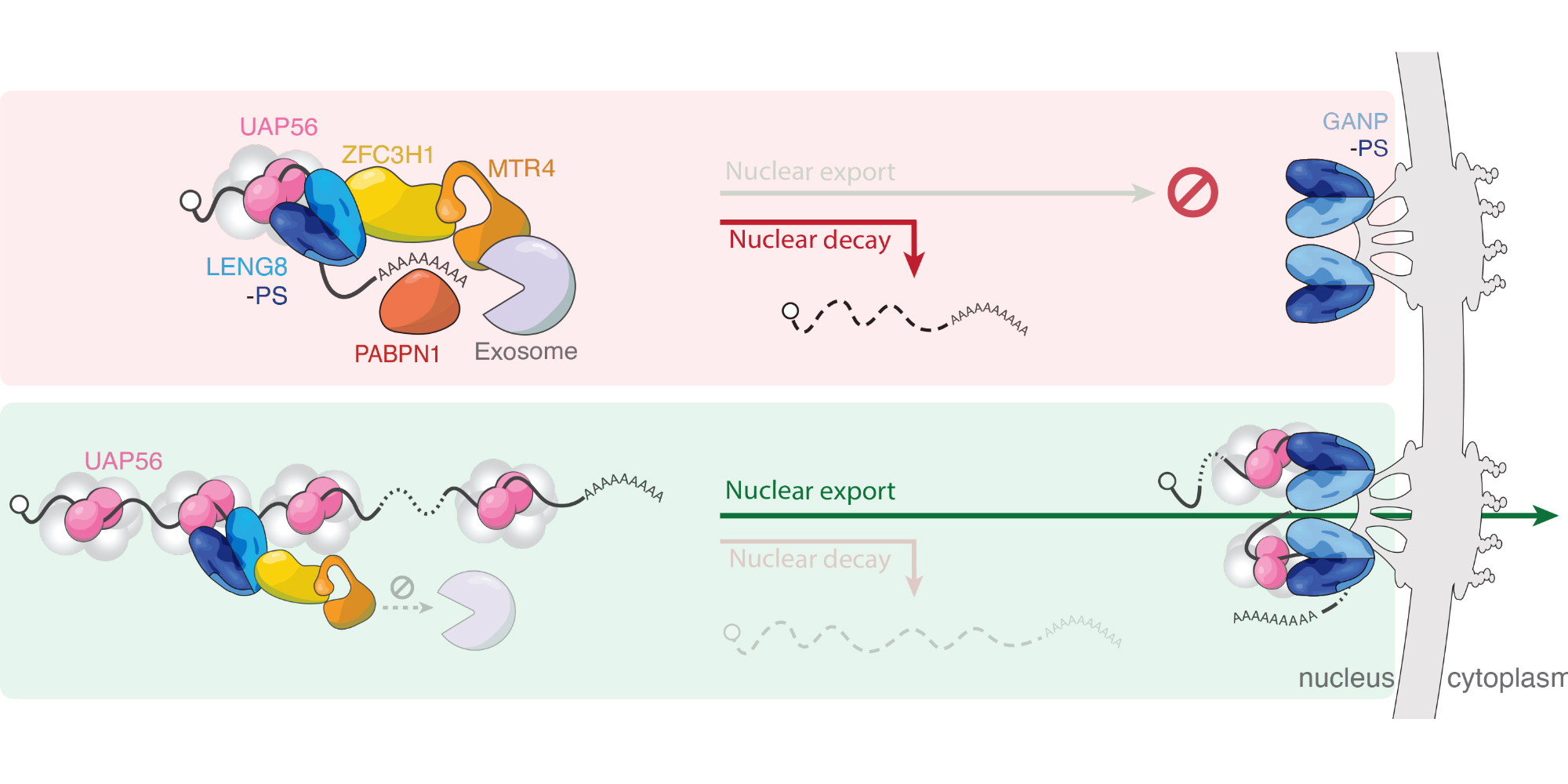
Implications of a new model for RNA fate determination
The findings provide a new framework for understanding how cells distinguish functional RNAs from non-functional ones and maintain the fidelity of gene expression.
The work also opens new avenues for research. One intriguing possibility is that PAXT-mediated retention of certain mRNAs in the nucleus could contribute to rapid cellular responses. Rather than exporting every mature mRNA immediately, cells may retain in the nucleus a reserve pool of transcripts that can be released and translated when conditions change.
The findings also raise new questions about how functional mRNAs avoid degradation by PAXT. Because shorter RNAs appear more vulnerable to nuclear decay, some mRNAs—particularly short ones—may have evolved additional protective mechanisms that allow them escape surveillance while still permitting cells to efficiently eliminate unwanted transcripts. Addressing these questions will be an important focus of future research. More broadly, the study suggests that RNA export and RNA degradation are not separate processes but competing outcomes of a shared molecular decision. Understanding how cells balance these opposing fates may uncover previously unknown layers of gene regulation operating within the nucleus.
Original publication
Andrii Bugai*, Ulrich Hohmann*, Ana Lorenzo*, Max Graf*, Laura Fin, Jérôme O. Rouvière, Laszlo Tirian, Yuhui Dou, Marion Le Rest, Patrik Polák, Dennis Johnsen, Lis Jakobsen, Jens Skorstengaard Andersen, Julius Brennecke#, Clemens Plaschka# and Torben Heick Jensen#. “Molecular basis of polyadenylated RNA fate determination in the nucleus”. Nature (2026).
*These authors contributed equally to this work
#Co-corresponding authors
Further Reading