Sascha Amann receives Vienna BioCenter PhD Award 2026
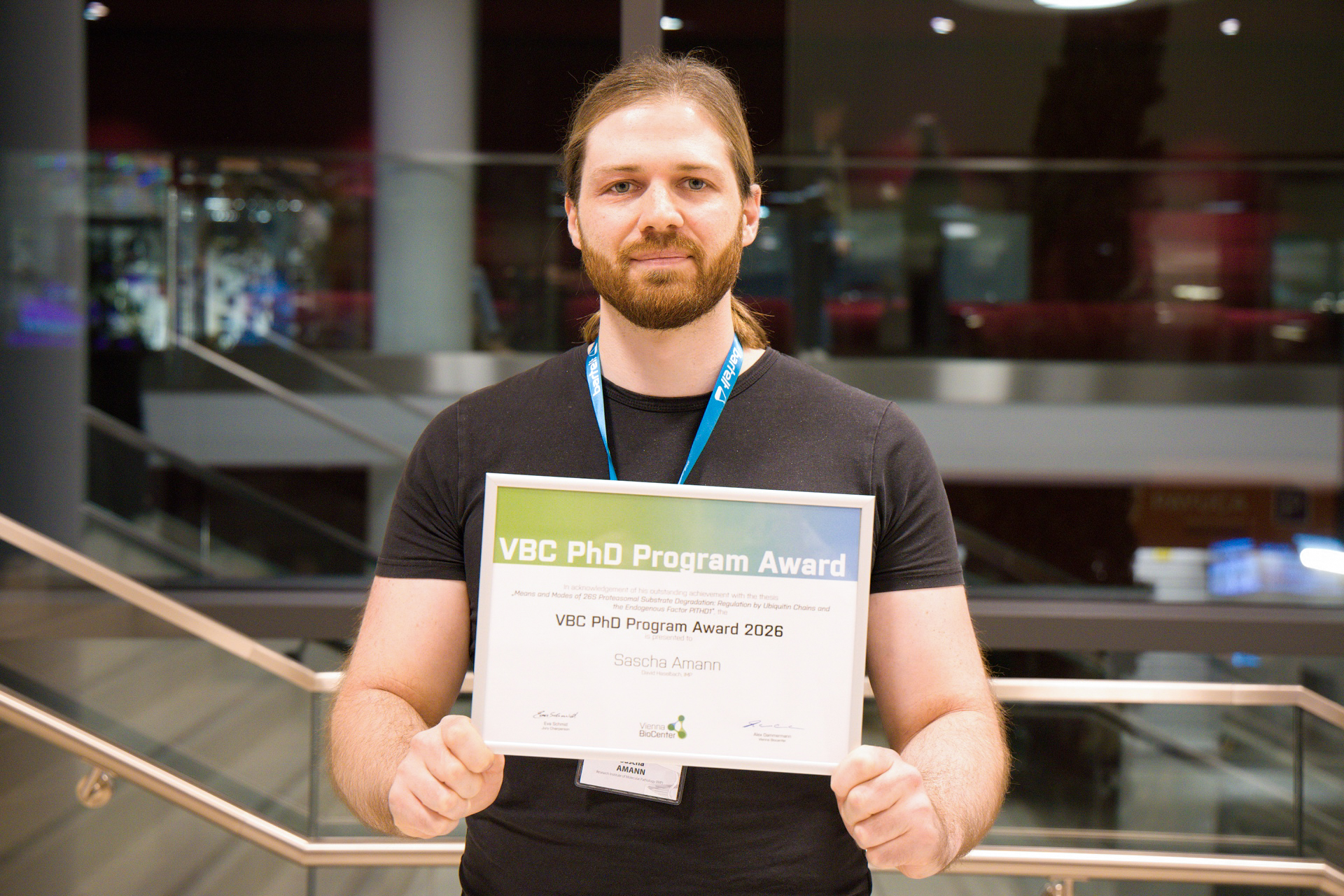
Sascha Amann, who recently completed his doctoral studies in David Haselbach's lab at the IMP, has received a 2026 Vienna BioCenter PhD Award for his research on how the proteasome recognises and breaks down proteins. The award is his second recognition for this work, following the 2026 Rabitsch Award.
At this year's Vienna BioCenter PhD Symposium, held under the theme "A Trail of Twists and Turns", Sascha Amann has been honoured with one of the Vienna BioCenter PhD Awards 2026 for his thesis, "Means and Modes of 26S Proteasomal Substrate Degradation: Regulation by Ubiquitin Chains and the Endogenous Factor PITHD1". The annual awards distinguish outstanding doctoral theses defended within the Vienna BioCenter PhD Program and highlight research excellence across the campus.
In his PhD work, Amann investigated how the proteasome—the cell's waste disposal machinery—recognises proteins marked for degradation. Proteins that are damaged or no longer needed are commonly tagged with chains of a small protein called ubiquitin. Combining biochemistry with cryo-electron microscopy, Amann studied how different types of ubiquitin chains interact with the proteasome's regulatory machinery. By recreating these interactions and determining their three-dimensional structures, he revealed how the proteasome recognises different molecular tags.
In a second project, Amann studied PITHD1, a protein that can block the proteasome from recognising proteins marked for degradation. This mechanism may allow cells to slow down protein breakdown during periods of dormancy, when they also produce fewer new proteins.
His doctoral research was also recognised with the 2026 Rabitsch Award, which honours an exceptional PhD student at the IMP or IMBA.
About Sascha Amann
Sascha Amann joined David Haselbach's lab at the IMP as a master's student in 2020 and began his PhD within the Vienna BioCenter PhD Program in February 2021. He successfully defended his thesis in summer 2026. He is continuing his work in the Haselbach Lab, finalising manuscripts from his doctoral research and collaborative projects, and plans to pursue a postdoctoral position to continue investigating the mechanisms of molecular machines.
Further reading