Julia Bubis receives ÖGMBT Life Sciences Research Award Austria
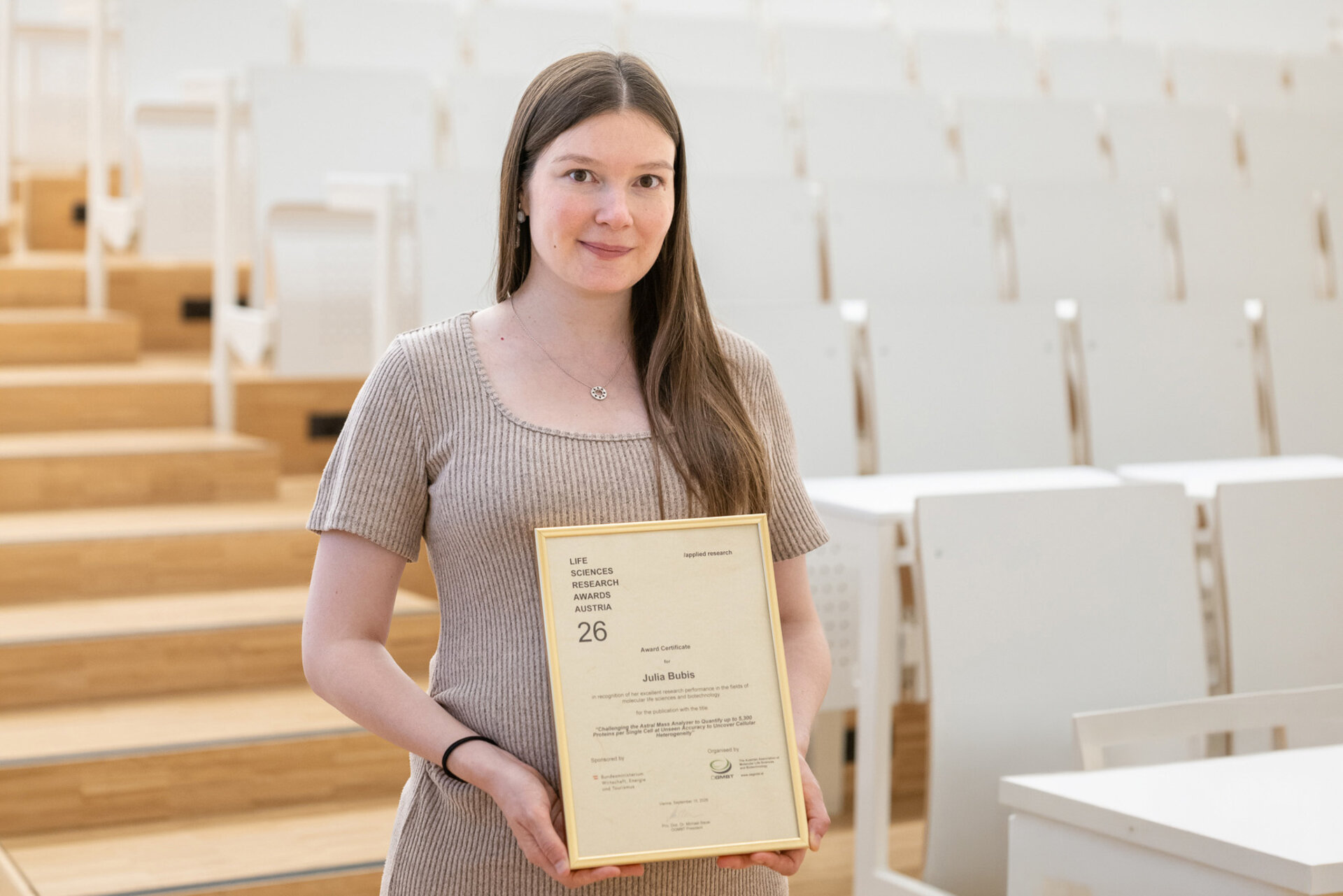
Julia Bubis, postdoc at the Proteomics Technology Hub of the Vienna BioCenter, has been awarded the 2026 Life Sciences Research Award Austria for developing a highly sensitive workflow that can quantify up to 5,300 proteins in a single cell. The award was presented during the 18th ÖGMBT Annual Meeting in Vienna on 15 September 2026.
Julia Bubis has been awarded first place in the Applied Research category of the Life Sciences Research Awards Austria 2026. Selected from twelve high-quality submissions, she received the award for her publication “Challenging the Astral mass analyzer to quantify up to 5,300 proteins per single cell at unseen accuracy to uncover cellular heterogeneity”, published in Nature Methods.
Bubis is a postdoc at the Proteomics Technology Hub, a joint facility of the Institute of Molecular Biotechnology of the Austrian Academy of Sciences (IMBA), the Gregor Mendel Institute (GMI), and the Research Institute of Molecular Pathology (IMP) at the Vienna BioCenter.
Every cell contains a rich and dynamic landscape of proteins, but important differences between individual cells can disappear when researchers analyse them in bulk. Single-cell proteomics brings these hidden variations into view. The challenge is that proteins—unlike DNA or RNA—cannot be amplified, making their detection in individual cells a demanding task that requires exceptionally sensitive and precise methods.
At the Proteomics Technology Hub, Bubis and her colleagues developed a workflow that brings together optimised sample preparation, liquid chromatography and the cutting-edge Astral mass analyser from Thermo Fisher Scientific. The result is an unprecedented level of depth and accuracy: up to 5,300 proteins quantified in a single cell. By bringing subtle differences between seemingly identical cells into view, the method opens new possibilities for studying small and naturally diverse biological systems, including models of early human development.
As shared first author, Bubis co-led the project with Manuel Matzinger, combining her design of the benchmarking framework and bioinformatic analysis with Matzinger’s expertise in liquid chromatography–mass spectrometry. The study also brought together Thermo Fisher Scientific and Nicolas Rivron’s group at IMBA, which contributed the cell models used to test the method.
“This award means a great deal to me—both as recognition of the methodological work behind this study and as encouragement to keep pushing single-cell proteomics forward,” says Bubis. “I am especially glad that this recognition comes from the broader life science community in Austria, rather than from within my own field alone.”
The award was presented during the 18th ÖGMBT Annual Meeting on 15 September 2026 at the University of Vienna Biology Building. The ceremony was moderated by ÖGMBT President Michael Sauer and attended by a representative of the Federal Ministry for Economy, Energy and Tourism.
About Julia Bubis
Julia Bubis earned her PhD in Analytical Chemistry from the Moscow Institute of Physics and Technology in 2022, where she specialised in developing high-throughput liquid chromatography–mass spectrometry methods and quantitation strategies. She subsequently joined the Proteomics Technology Hub at the Vienna BioCenter as a postdoctoral researcher. Bubis is the principal investigator of the Austrian Science Fund ESPRIT project “Single-cell Proteomics of Human Blastoid”. Her work focuses on advancing liquid chromatography–mass spectrometry and data-analysis techniques for single-cell proteomics, with the aim of improving our understanding of early embryonic development using blastocyst-like structures. Her previous distinctions include a Marie Skłodowska-Curie Actions Seal of Excellence in 2023 and the Best Poster Award at the Single Cell Proteomics Conference in Boston in 2024.
About the Life Sciences Research Awards Austria
The Life Sciences Research Awards Austria, organised by the Austrian Association of Molecular Life Sciences and Biotechnology (ÖGMBT), recognise outstanding scientific publications by young researchers in the fields of life sciences and biotechnology. Supported by the Federal Ministry for Economy, Energy and Tourism, the awards honour excellence and innovation in basic and applied research. The ÖGMBT is Austria’s largest network for molecular life sciences and biotechnology, bringing together scientists, professionals, and institutions to promote research, collaboration, and innovation.
Further reading
“Challenging the Astral mass analyzer to quantify up to 5,300 proteins per single cell at unseen accuracy to uncover cellular heterogeneity.” Nature Methods (2025)