Cracking the pathogen playbook
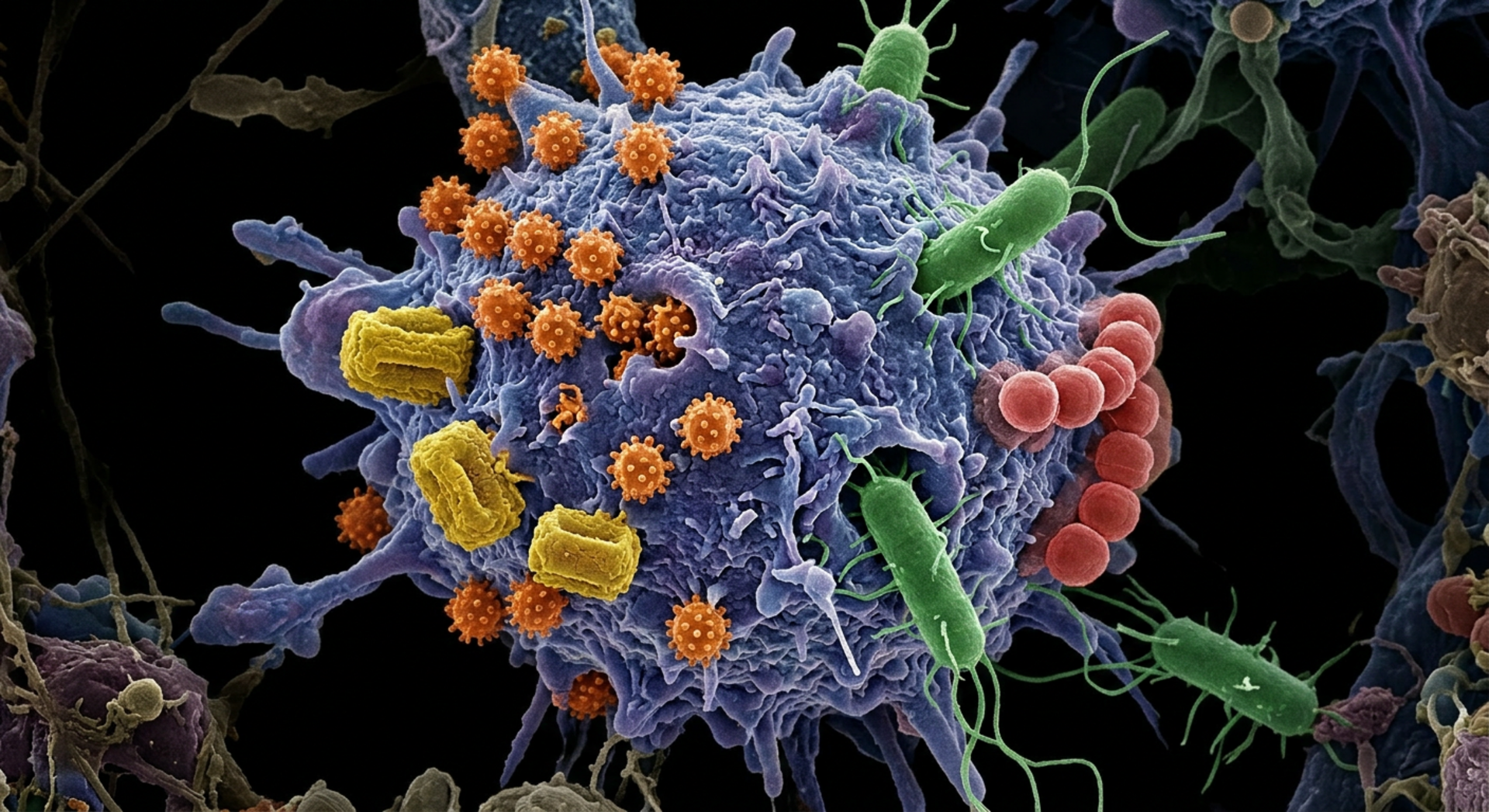
Viruses, bacteria, and parasites have spent millions of years evolving proteins that manipulate the cells they infect. Genome sequencing has revealed thousands of genes encoding such pathogen proteins, yet scientists still do not know what most of them do. Researchers from the lab of Alexander Stark at the IMP and the lab of Mikko Taipale at the University of Toronto have now developed a powerful new platform to systematically discover what pathogen proteins do inside human cells. Their work, published in the journalCell, reveals hundreds of previously unknown protein functions and provides a new resource for studying infection and fundamental cell biology.
At least 2,000 viruses, bacteria, and parasites are known to infect humans. Despite their enormous diversity, they share a common challenge: to survive, they must manipulate the cells they infect. Over millions of years of evolution, many pathogens have developed specialised proteins that help them hijack cellular processes and evade the body's defences.
Advances in genome sequencing have revealed thousands of these pathogen proteins, often called effectors. Yet despite their central role in infection, scientists still do not know what most of these effectors do. As pathogen genomes sequences accumulate faster than ever before, discovering the function of these molecular tools has become one of the major challenges in infection biology.
Researchers from the lab of Alexander Stark at the IMP, in collaboration with the lab of Mikko Taipale at the University of Toronto, have now developed a powerful new platform that transforms how scientists study pathogen proteins. Applying it to nearly 4,000 proteins from viruses, bacteria, and parasites, the team discovered hundreds of previously unknown functions and built the first large-scale map of how pathogens manipulate human cells. Their findings are published in the journal Cell.
A platform to explore thousands of pathogen proteins
"Pathogens have spent millions of years learning how to control human cells. Their proteins are essentially a library of evolutionary solutions to biological problems," says Alexander Stark, Senior Group Leader at the IMP and co-corresponding author of the study.
To systematically discover what these proteins do, the scientists created the eORFeome, one of the largest collections of pathogen genes ever assembled. The library contains nearly 4,000 genes from viruses, bacteria, and parasites that encode proteins known or predicted to enter human cells during infection. This allows researchers to produce and study each pathogen protein individually in human cells, directly linking each protein to its specific effect on the cell.
Unlike traditional approaches, which typically focus on a single pathogen, the eORFeome made it possible to compare proteins from viruses, bacteria, and parasites within the same experimental framework. Rather than looking for how one pathogen manipulates a cell, the researchers could search for broader patterns shared across many different pathogens.
"Instead of asking how one virus or one bacterium manipulates a cell, we asked how many different pathogens manipulate the same cellular process," says Tomas Pachano, postdoctoral researcher in the Stark lab and co-first author of the study. "This allowed us to discover patterns that simply couldn't be seen before."
One of the biggest surprises was that evolution repeatedly arrived at similar solutions in completely different pathogens. Although viruses, bacteria, and parasites are separated by millions of years of evolution, many were found to target the same cellular pathways—sometimes using remarkably similar strategies, sometimes through entirely different mechanisms.
"What surprised us most was seeing how unrelated pathogens converged on the same cellular targets," says Pachano. "It shows that evolution has repeatedly found effective ways to manipulate human cells.”
With the eORFeome now established, researchers have a powerful new resource to investigate thousands of pathogen proteins and the roles they play during infection. In the future, this knowledge could help scientists better understand newly emerging pathogens, discover previously unknown aspects of human cell biology, and possibly identify new opportunities for therapeutic intervention.
"What excites me most is that we can now systematically explore the biology of thousands of previously uncharacterised proteins," says Stark. "We've built a toolkit to discover how pathogens evolved to take control of human cells. I'm excited to see how these evolutionary solutions will deepen our understanding of cell biology and eventually inspire new applications in synthetic biology."
Original publication
Tomas Pachano*, He Leng*, Guillaume Dugied, Travis Tribble, Vincent Loubiere, Felix Rauh, Yeojin Lee, Alexander Schleiffer, Veronika Young, Benjamin Weller, Eleanor A. Lyons, Matthew R. Hass, Leah C. Kottayan, Matthew T. Weirauch, Juan I. Fuxman Bass, Hayley J. Newton, Alexander W. Ensminger, Pascal Falter-Braun, Daniel Schramek, Alexander Stark# and Mikko Taipale#. “Systematic Discovery of Pathogen Effector Functions across Human Pathogens and Pathways”, Cell (2026), DOI: 10.1016/j.cell.2026.06.017
*These authors contributed equally to this work
#Co-corresponding authors
Further reading
About the IMP
The Research Institute of Molecular Pathology (IMP) in Vienna is a basic life science research institute largely sponsored by Boehringer Ingelheim. With over 220 scientists from 40 countries, the IMP is committed to scientific discovery of fundamental molecular and cellular mechanisms underlying complex biological phenomena. The IMP is part of the Vienna BioCenter, one of Europe’s most dynamic life science hubs with 2,800 staff members from over 80 countries in seven research institutions, two universities, and 42 biotech companies. www.imp.ac.at, www.viennabiocenter.org