AI learns to write code that activates genes in mammals
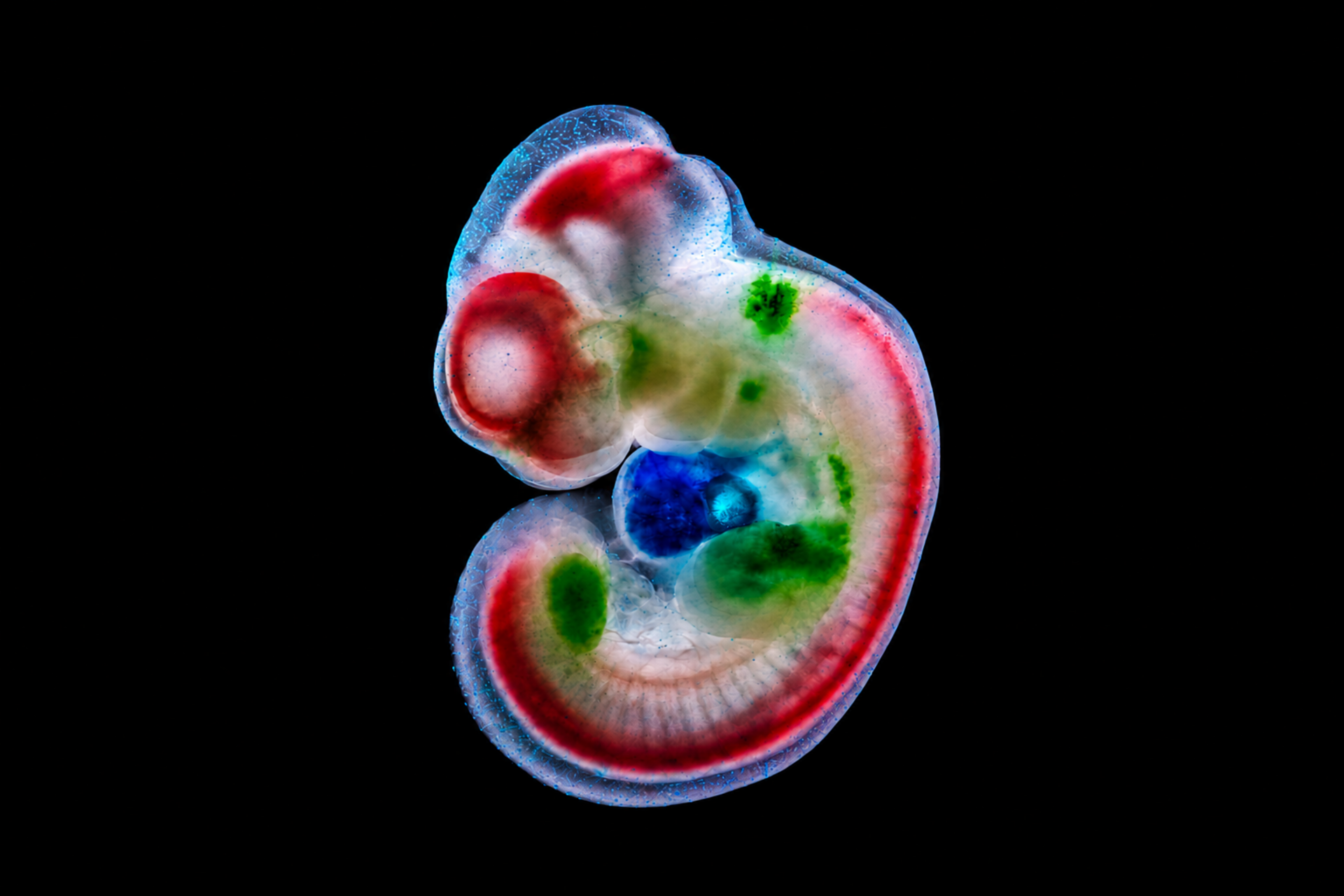
Could scientists ever write the DNA instructions that tell cells which genes to switch on? Researchers from the lab of Alexander Stark at the IMP have now shown that they can, using artificial intelligence to design enhancers—DNA switches that control gene activity—for specific mouse tissues. Published in Nature Genetics, the study marks the first successful design of enhancers from scratch for a mammal, bringing programmable gene expression as a therapeutic approach a step closer to reality.
Every cell in our body carries the same DNA. Yet a heart cell beats, a neuron sends electrical signals, and an immune cell fights infection. What makes them different is not the genes they contain, but which genes they switch on, or express.
The instructions that determine which genes are active in each cell are encoded in short stretches of DNA called enhancers. Acting as molecular switches, enhancers determine when, where, and how strongly nearby genes become active, orchestrating everything from embryonic development to the daily function of our organs.
Scientists have spent decades trying to understand the language of enhancers. Like the genetic code that provides the instructions for making proteins, this regulatory code is written in the four letters of DNA. But its rules are far more complex. This complexity led many researchers to question whether the regulatory code could ever be fully deciphered—whether scientists would one day be able to read and potentially even write this second code of life.
Reading and writing the regulatory code enables much more than addressing research questions in biology. It could allow scientists to write their own genetic instructions, directing where and when genes are switched on with unprecedented precision to study development, change features of cells, and use this technology for example to develop more precise targeted therapies.
Now, researchers in the lab of Alexander Stark at the IMP have shown that the language of enhancers can be deciphered—and even written—in mammals. Using artificial intelligence (AI), they designed entirely new synthetic enhancers that activate genes specifically in the heart, limbs, or nervous system of mice. The work demonstrates for the first time that scientists can write DNA sequences that direct gene activity in a mammal, opening the door to programming gene activity also in humans. Their findings are published in the journal Nature Genetics.
How AI learned to write genetic switches
First, the researchers set out to teach an AI model the language of mammalian gene regulation.
"One of the biggest challenges was that only a few hundred validated enhancers are available for most tissues," says Shenzhi Chen, Vienna BioCenter PhD student in the Stark lab. "That's far too little to train an AI model from scratch. By first learning from large genome-wide datasets and then fine-tuning on validated enhancers, we were able to overcome this limitation."
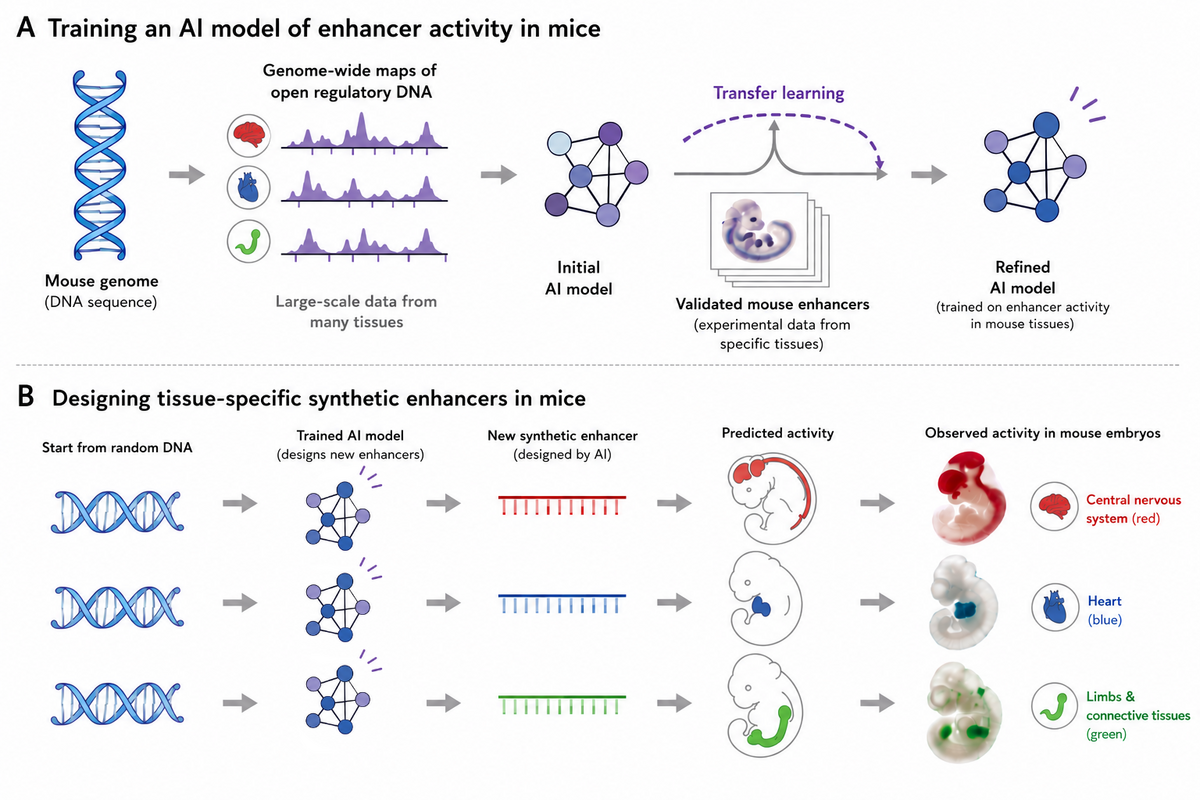
Instead of relying solely on the small number of known enhancers, the scientists first trained the AI on genome-wide maps showing which stretches of DNA are open and available to the proteins that regulate gene activity in different mouse tissues. These maps taught the model the general features of regulatory DNA. The researchers then refined the AI using the experimentally validated enhancers—a machine-learning strategy known as transfer learning—allowing it to learn the specific DNA patterns that switch on genes in different tissues.
The work builds on a previous study by the Stark lab, which showed that AI could design functional synthetic enhancers in fruit flies. Demonstrating that the same strategy could work in mammals, however, was difficult because mammalian gene regulation is substantially more complex.
With the AI trained on mammalian gene regulation, the researchers put it to the ultimate test: create entirely new enhancer sequences that had never existed in nature. Starting from randomly generated DNA, the AI designed synthetic enhancers predicted to activate genes specifically in the heart, limbs, or nervous system of developing mouse embryos.
To put these predictions to the test, the Stark lab teamed up with Evgeny Kvon at the University of California, Irvine, an expert in mouse development and Stark’s very first PhD student more than a decade ago. Kvon’s team selected fifteen candidates and coupled each enhancer to an easily detectable reporter gene that does not normally exist in mice. They then introduced these constructs into mouse embryos, allowing the researchers to see whether—and where—each synthetic enhancer activated reporter gene expression.
The results exceeded the researchers' expectations. Every synthetic enhancer tested activated genes in its intended tissue, giving the researchers a 100 percent success rate.
"We were surprised that all fifteen enhancers worked," says Vincent Loubiere, former postdoc in the Stark lab. "That tells us that the regulatory language encoded in mammalian DNA is much more systematic and learnable than many people had expected."
The researchers also showed that the approach can be applied to tissues for which no experimentally validated enhancers exist. Instead of relying on scarce experimental data, the AI can integrate multiple genome-wide maps of various features, which can provide clues about which sequences are likely to be active. This opens the possibility of designing genetic switches for many more tissues, developmental stages, and disease models.
The study lays the foundation for programming gene expression with unprecedented precision. In the future, tailor-made enhancers could activate therapeutic genes only in selected tissues or cell types, making gene therapies safer and more effective while providing powerful new tools to study development and disease.
"For almost twenty years, our vision has been to understand gene regulation well enough that we could eventually write it," says Stark. "This study shows that this is possible in mammals. I think it marks the beginning of a new era in which we can design genetic switches for virtually any tissue and cell type, including those of humans."
Original Paper
Shenzhi Chen, Vincent Loubiere, Ethan W. Hollingsworth, Ken Murakami, Nikolaus Mandlburger, Sandra H. Jacinto, Atrin Dizehchi, Jacob Schreiber, Evgeny Z. Kvon, Alexander Stark: “Predictive design of tissue-specific mammalian enhancers that function in the mouse embryo”. Nature Genetics (2026), DOI: https://www.nature.com/articles/s41588-026-02729-1
About the IMP
The Research Institute of Molecular Pathology (IMP) in Vienna is a basic life science research institute largely sponsored by Boehringer Ingelheim. With over 220 scientists from 40 countries, the IMP is committed to scientific discovery of fundamental molecular and cellular mechanisms underlying complex biological phenomena. The IMP is part of the Vienna BioCenter, one of Europe’s most dynamic life science hubs with 2,800 staff members from over 80 countries in seven research institutions, two universities, and 42 biotech companies. www.imp.ac.at, www.viennabiocenter.org