How cells import their waste disposal machine into the nucleus
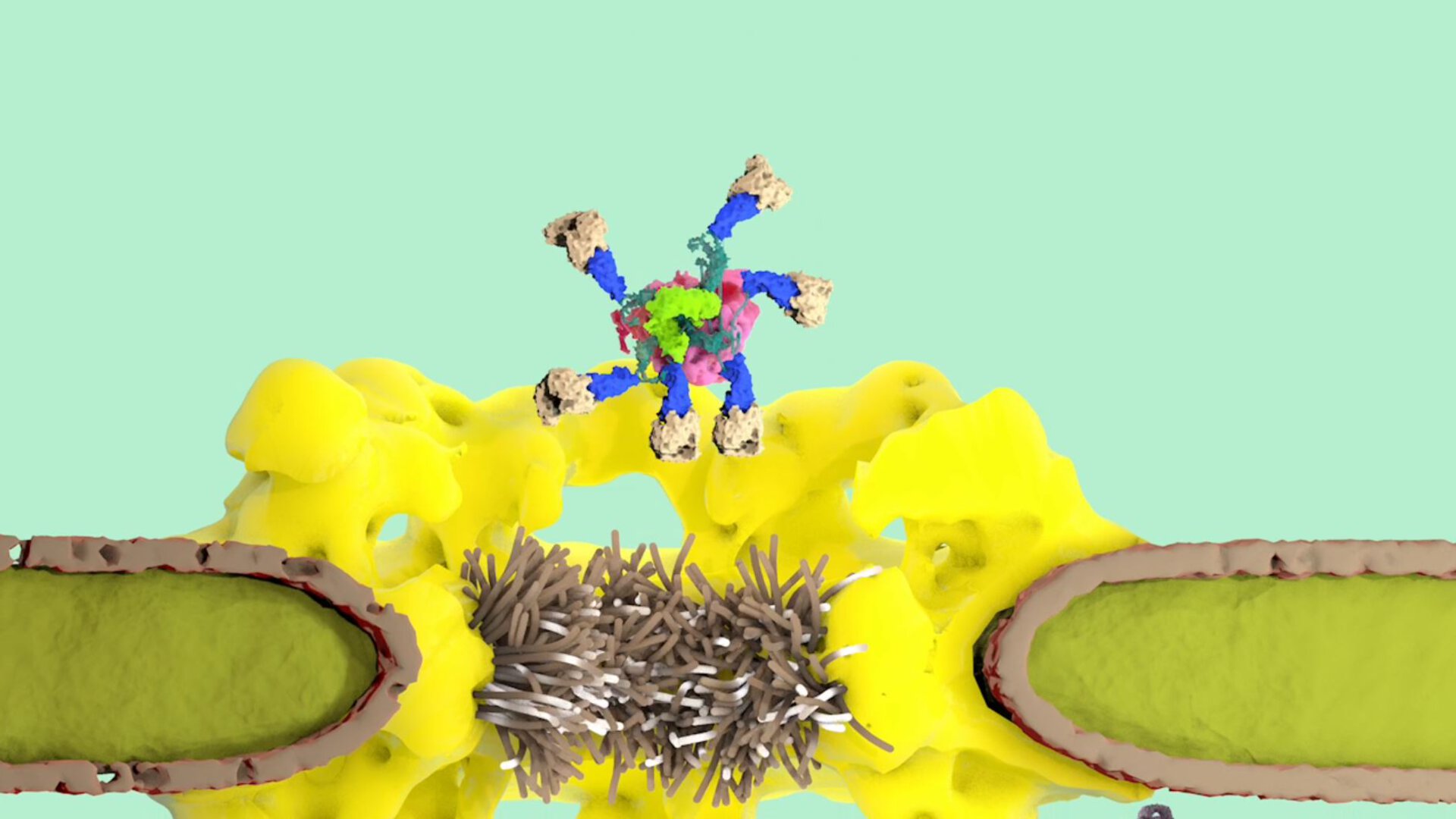
Proteasomes are the cell’s waste disposal machines, breaking down damaged or unwanted proteins to keep cellular processes running smoothly. But to regulate gene activity, proteasomes must also enter the nucleus — a challenge, given their enormous size. Researchers from the labs of David Haselbach and Johannes Zuber at the IMP now reveal how the adaptor protein AKIRIN2 helps proteasomes gain access to the nucleus, discovering a new principle for transporting large molecular machines. Their findings are published in the journal Nature Communications.
To stay functional, every cell depends on an efficient waste disposal system that removes damaged, misfolded, or no-longer-needed proteins. At its core is the proteasome, a molecular machine that carries out this cleanup job. In the nucleus, where proteins control gene activity and other essential processes, this continuous upkeep is particularly important to keep protein levels in balance and prevent disruption.
Proteasomes operate throughout the cell, both in the cytoplasm and in the nucleus. In the nucleus in particular, protein degradation plays a crucial role: many regulatory proteins, such as transcription factors, are produced and destroyed rapidly, allowing cells to respond quickly to changing conditions. Instead of transporting thousands of these short-lived proteins out of the nucleus for degradation, cells take a more efficient approach and bring the waste disposal machinery directly to where it is needed.
Proteasomes are among the largest protein complexes in the cell, and it was unclear how they could make their way into the nucleus at all. Most proteins enter the nucleus with the help of transport factors called importins, which recognise short nuclear localisation signals — a strategy that works well for small cargos, but poses a major challenge for something as large as the proteasome.
Researchers from the labs of David Haselbach and Johannes Zuber at the IMP, had previously identified the small adaptor protein AKIRIN2 as a key factor required for proteasome import. In a new study, they partnered with collaborators to reveal how AKIRIN2 performs this task at the molecular level, uncovering a new mechanism cells use to move large molecular machines across the nuclear envelope. Their findings are published in the journal Nature Communications.
A new mechanism for importing huge molecular machines
Understanding how AKIRIN2 works posed a major challenge. The protein is largely unstructured and highly unstable, making it difficult to study using conventional biochemical and structural approaches. “AKIRIN2 doesn’t look like a transport protein at all,” says David Haselbach, Technology Platform Head at the IMP. “It’s mostly intrinsically disordered, prone to aggregation and degradation, and extremely hard to purify. That’s one reason it remained invisible for so long.”
Instead of trying to study AKIRIN2 in isolation, the researchers turned to an unusually systematic strategy in living cells. They mutated every single amino acid in AKIRIN2, generating thousands of protein variants. Testing these variants in human cells produced a detailed functional map of AKIRIN2, revealing which regions are essential for proteasome import. This map then served as a guide for the next step: identifying the transport partners that AKIRIN2 interacts with and rebuilding the import machinery piece by piece. Using purified proteins, the team recreated the proteasome import system in the laboratory and analysed it using cryo-electron microscopy.
The structures revealed a striking mechanism: AKIRIN2 binds directly to the proteasome and acts as an adaptor that draws nuclear transport receptors to its surface. Rather than working as a single molecule, AKIRIN2 assembles in multiple copies on the proteasome, effectively coating it with transport factors and turning the proteasome into a cargo that the nuclear pore can recognise. “This clustering is the key,” explains Haselbach. “The proteasome is enormous compared to most nuclear cargos. By bringing in multiple transport receptors at once, AKIRIN2 solves the size problem of nuclear transport.”
Once inside the nucleus, the transport complex is dismantled in an elegant way: the proteasome itself breaks down AKIRIN2. This ensures that this waste disposal machine is released and retained in the nucleus, ready to get back to its job.
These findings uncover how proteasomes make their way into the nucleus despite their enormous size. The work points to a broader principle: cells may use small adaptor proteins as molecular “connectors” to guide large protein complexes through the nuclear pore.
“This is likely not unique to the proteasome,” says Haselbach. “We are beginning to see similar adaptor proteins for other large nuclear complexes. It suggests that cells use a general strategy to move big molecular machines into the nucleus, even though the adaptors themselves are evolutionarily unrelated.”
Original Publication
H. L. Brunner, R. W. Kalis, L. Grundmann, Z. Hodáková, Z. Koskova, I. Grishkovskaya, M. de Almeida, M. Hinterndorfer, H. Knaudt, S. Höfflin, F. Andersch, H. Kotisch, A. Dickmanns, S. Cuylen-Haering, J. Zuber & D. Haselbach “A multivalent adaptor mechanism drives the nuclear import of proteasomes.” Nature Communications (2026). DOI: 10.1038/s41467-026-69162-0