From IMP postdocs to group leaders: Laura Lorenzo-Orts and Ulrich Hohmann start their labs at IMB Mainz
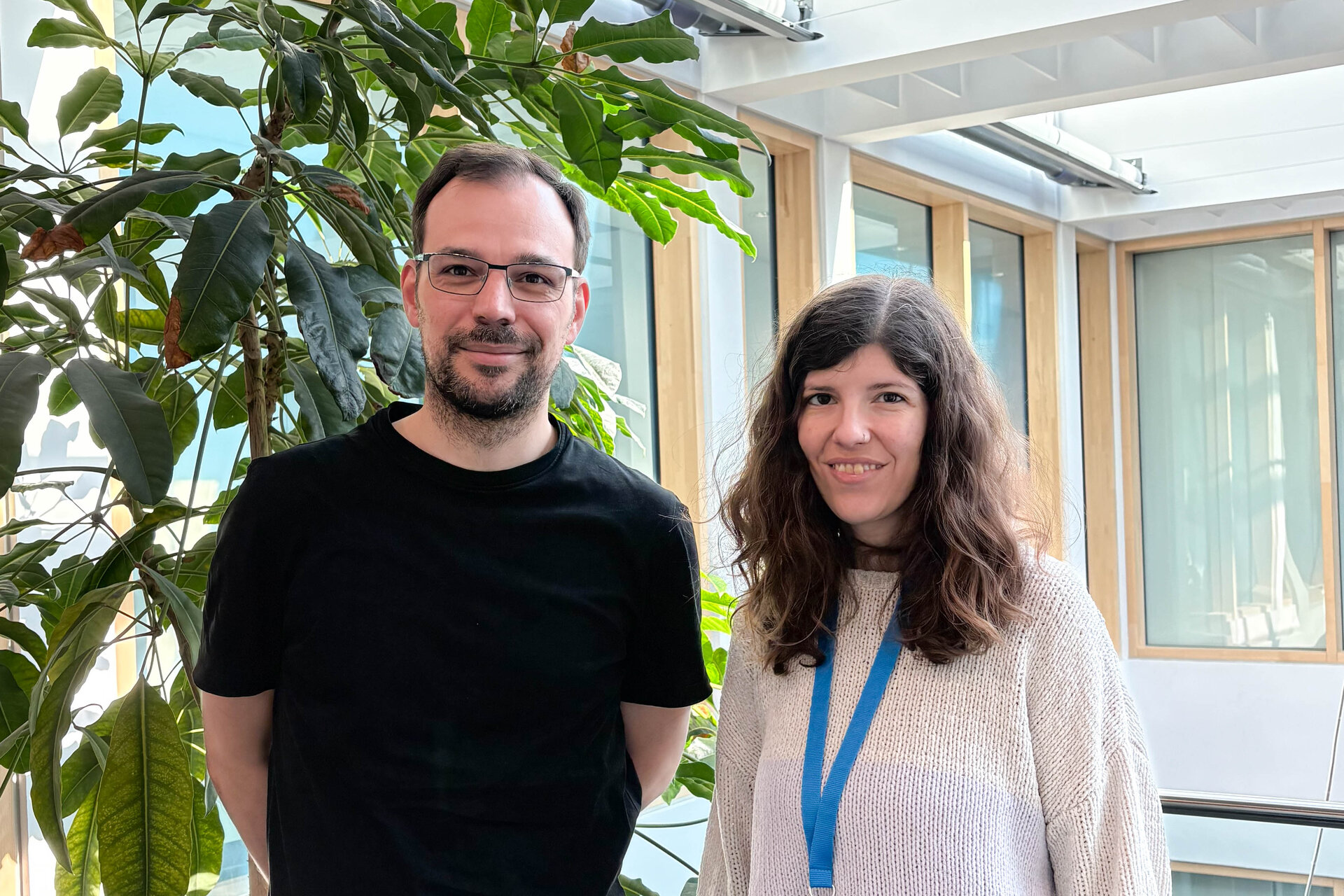
This year, two former IMP postdocs, Laura Lorenzo-Orts and Ulrich Hohmann, took the next big step in their scientific careers: both have started independent research groups at the Institute of Molecular Biology (IMB) in Mainz, Germany. Securing two group leader positions at the same institute is no small feat. The IMB’s flexibility and commitment made this dual hire possible, creating an opportunity that works both scientifically and personally. We spoke with Laura and Ulrich about their research at the IMP, their motivations for becoming group leaders, and what it’s like to build a lab from scratch.
What did you work on during your time at the IMP?
Laura Lorenzo-Orts:
I was a postdoc in Andrea Pauli’s lab, where I studied how messenger RNAs that are stored in the egg are kept translationally repressed. This is important because the egg needs to save energy and prevent premature protein synthesis during early development. During my postdoc, I found two different mechanisms that eggs and early embryos use to repress translation. In one project, we showed how ribosomes can be kept dormant. In another, I identified a factor that keeps specific mRNAs repressed.
Ulrich Hohmann:
I worked on understanding how mRNAs are exported from the nucleus. I was jointly supervised in the labs of Clemens Plaschka at the IMP and Julius Brennecke at IMBA (Institute of Molecular Biotechnology). In the Brennecke lab, we studied a non-canonical RNA in the Drosophila germline that hijacks the mRNA export machinery. We then used this knowledge in the Plaschka lab to understand how canonical mRNA export works in all cells. This allowed us to reveal how a central factor in mRNA export functions at the molecular level and to propose a model for how the export machinery comes together and moves an mRNA out of the nucleus.
You both joined the IMP in 2019. What did you learn here that helped prepare you for leading your own lab?
Ulrich:
What I really appreciated — not only at the IMP, but across the Vienna BioCenter — is the collaborative atmosphere. People genuinely work together to solve problems. If you hear about a technique in a seminar that could help your project, there’s basically no barrier to approaching someone and asking for advice or reagents. That openness is quite unique, and it’s something we actively looked for when applying for group leader positions.
Laura:
I completely agree. For example, my ribosome project was done in collaboration with David Haselbach. We didn’t have the necessary expertise for certain techniques in our lab, so working together was essential to make the story possible. Another key aspect of the Vienna BioCenter is the core facilities. Having experts who support your experiments and with whom you can discuss ideas is incredibly valuable. That level of institutional support really shapes how you think about building your own lab.
When did you decide that you wanted to become group leaders?
Laura:
For me, it wasn’t a decision I made early on. I just really enjoy doing basic science. I like having the freedom to explore fundamental questions without necessarily focusing on immediate applications. During my postdoc, it gradually became clearer that I wanted to continue in academia. I felt very supported in that process, especially by Andi [Andrea Pauli], both in discussions and during the application phase.
Ulrich:
What motivates me most are those rare moments in research when you discover something new — when you realise you’ve figured out something that nobody knew before. Those are incredibly exciting moments. If you want to continue experiencing that, becoming a group leader is a natural step. It allows you to keep asking new questions and building on your ideas.
Finding two group leader positions at the same institute is not easy. How did you approach that process?
Ulrich:
It’s true that finding two independent positions at the same institution can be challenging. We were very open about this wherever we applied. Many places are limited by administrative boundaries or structural constraints. What we appreciated about IMB was the flexibility and determination to make a dual hire possible.
What are you most excited to study in your new labs at the IMB?
Laura:
I will continue working on early development in zebrafish. During my postdoc, I focused on how translation is repressed. Now I’m interested in the opposite question: how stored mRNAs become activated. I want to identify the mechanisms that remove the repressive marks we discovered earlier. I’ve been fascinated by RNA biology since my PhD, and I’m excited to build my own research around these questions.
Ulrich:
During my postdoc, we developed a mechanistic model for how mRNA export works. Now I’m excited to explore the regulatory layers that make mRNA export specific to certain cell types or physiological conditions. I’m also interested in non-canonical export pathways, such as those that occur in the germline. Now that we have the basic framework we can start asking how it’s fine-tuned in different cells and under different conditions.
What has it been like to start your labs from scratch?
Laura:
In the beginning, it’s a bit chaotic. You receive an empty space filled with boxes — it feels a bit like unpacking after moving to a new house, which we also did. You have to figure out who is responsible for what, recruit people, and organise everything from the ground up. Compared to being in an already well-running lab, it’s much slower, but it’s also very exciting.
Ulrich:
What really surprised me is how long routine things take when you’re new somewhere. At the Vienna BioCenter, so much infrastructure is already in place, from lab organisation to IT systems. When you start somewhere new, you suddenly realise how much invisible support there was. Now, even simple things like sourcing materials or understanding institutional processes take more time. But having experienced such a well-organised environment definitely helps us think about how we want to set up our own labs. Having said that, the support we receive at the IMB is great!
What advice would you give to current postdocs who hope to start their own lab one day?
Laura:
Enjoy the ride. It’s good to have a long-term goal, but it shouldn’t be the only thing driving you. You have to genuinely enjoy what you’re doing now.
Ulrich:
If becoming a group leader is your goal, choosing the right postdoc lab is extremely important. A supportive environment makes a huge difference. We were fortunate to have mentors who were flexible and supportive throughout our transition.
Further reading
Lorenzo-Orts lab at IMB Mainz
Hohmann lab at IMB Mainz
Lab of Andrea Pauli
Lab of Clemens Plaschka
Lab of Julius Brennecke