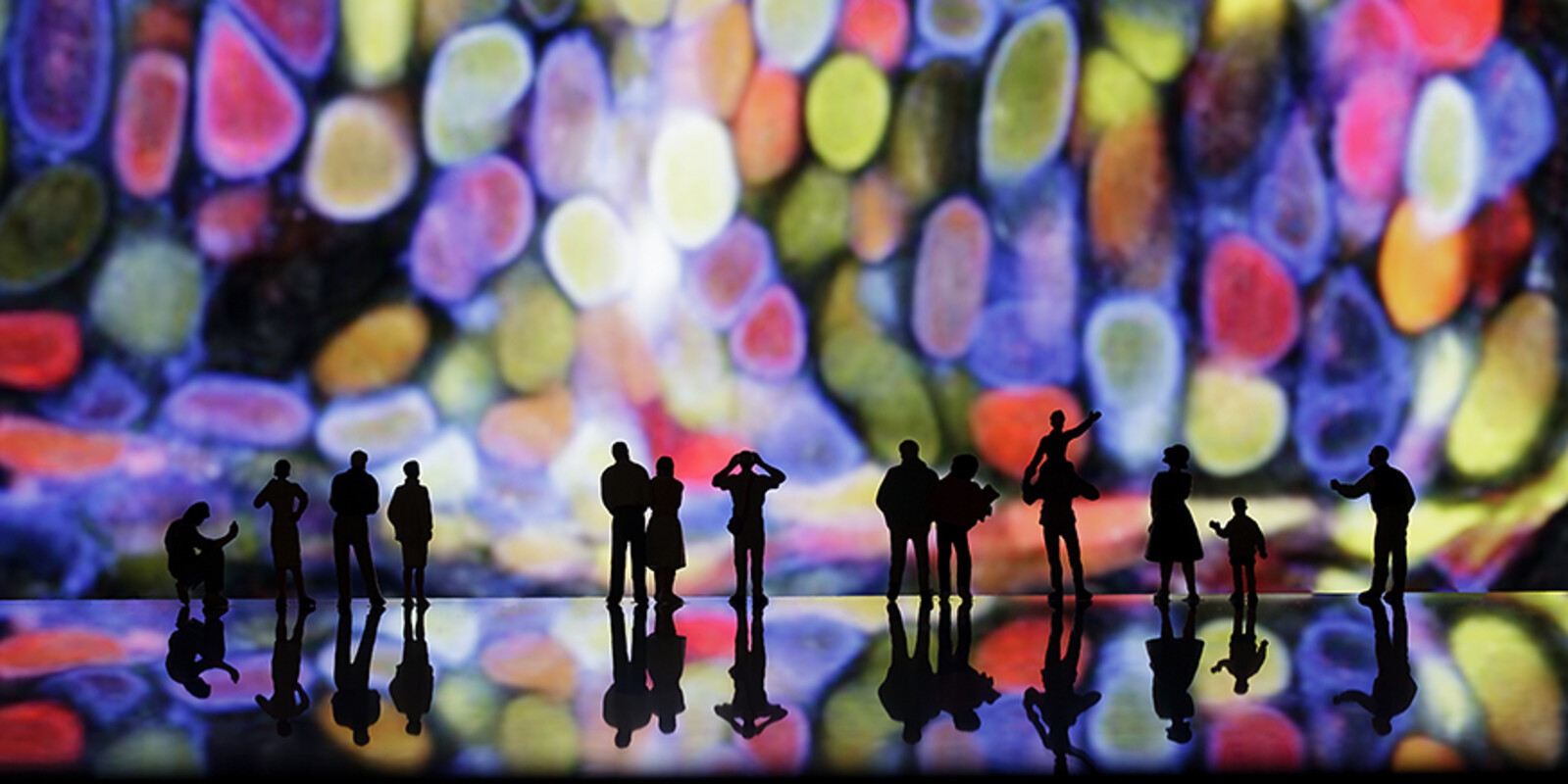
'Science first' is the motto of the IMP. Researchers are provided with facilities, support staff and funds to focus on what they do best: world-class molecular biology. The questions they address are defined by group leaders and their creativity is not constrained. Our research areas are therefore derived from the curiosity of our principal investigators.
IMP Group Leaders on their research


The common goal of IMP scientists is to elucidate the mechanisms and principles that underlie complex biological processes. Our independent research groups currently work in the following areas:
From small RNAs to Megadalton-sized protein complexes, the sophisticated functions of living cells are carried out by thousands of different molecules. They generate energy, transmit signals, move components, and coordinate cellular events in space and time. How do these molecules work and cooperate to create life as an emergent property and to control its numerous functions?
At the IMP, scientists from several labs use synergistic approaches to tackle these questions. Strong scientific support and technology developments in protein chemistry, bio-optics, electron microscopy, and genomics provide an experimental foundation to functionally dissect the molecular mechanisms of the cell.
The following labs at the IMP address questions that relate to this field: Tim Clausen; Andrea Pauli; Diana Pinheiro; Jan-Michael Peters; Sven Klumpe.
Understanding the molecular structures of biological macromolecules, especially proteins, and learning how they acquire these structures is the basis for understanding their functions and how alterations in the structures affect these functions.
At the IMP, scientists from different labs employ atomic structure determination, single molecule biochemistry, cryo-electron microscopy, X-ray crystallography and mass spectrometry, the latter with a particular focus on the analysis of post-transcriptional modification and quantification approaches especially for detecting phosphorylation, protein complex stoichiometry, and system-wide cellular analyses to address structure and function at multiple scales, providing a comprehensive view of how molecular mechanics control cellular biology.
The following labs at the IMP address questions that relate to this field: Tim Clausen; Jan-Michael Peters; Francisco Balzarotti; Clemens Plaschka; Sven Klumpe; and David Haselbach (Technology Platform).
The mammalian genome with its ~25,000 genes contains the genetic information for directing the development of a totipotent zygote into a multicellular organism. As the function of only a minority of these genes is currently known, it is an important scientific challenge to identify and characterise key genes and their molecular mechanisms that contribute to embryonic development, cell lineage differentiation and cell function in health and disease.
At the IMP, several groups combine their expertise to investigate these differentiation processes in several animal models and human cell systems. By taking advantage of the power of genetics combined with molecular biology, biochemistry, system-wide cellular analyses, advanced light and electron microscopy, genome-wide sequencing and high-throughput siRNA approaches, we provide novel insight into the molecular functions of regulatory factors, effector molecules and structural proteins in embryogenesis, cell division, haematopoiesis, leukaemia development and neurodevelopmental disease.
The following labs at the IMP address questions that relate to this field: Meinrad Busslinger; Francisco Balzarotti; Andrea Pauli; Jan-Michael Peters; Clemens Plaschka; Alexander Stark; Johannes Zuber.
By following stem cells and their prodigy over the course of their differentiation and development, scientists at the IMP try to learn more about the means by which undifferentiated cells acquire tissue-specific properties or how they divide to produce more stem cells and their characteristics.
How do cells know which properties to take? How do they know where they are within an organism and when to enter which program of acquiring different properties? Is this done differently in developing versus adult organisms? And which diseases occur when developmental programs go wrong? These questions can be addressed with respect to the differentiation of cells, tissues, organs and entire organisms, ultimately leading to fields such as organ regeneration with high medical relevance.
The following labs at the IMP address questions that relate to this field: Meinrad Busslinger; Anna Obenauf; Andrea Pauli; Diana Pinheiro; Alexander Stark; Johannes Zuber
Studying how organisms develop and how cells grow, divide and differentiate inherently leads to the question of how these processes are controlled and what causes the control mechanisms to fail.
On the organismic level, the body’s complex immune system controls the interaction with possible intruders such as pathogenic microorganisms. Scientists at the IMP study how the various immune cells develop from their progenitors, what guides their differentiation and how they generate the vast repertoire of antibodies. To this end, they use mouse transgenic, cell biological, and genome-wide molecular approaches including RNAi screens.
It takes multiple control and repair mechanisms to fail in order for malignancies to develop. The mutations that cause cells to override these controls and that can ultimately lead to cancer are rather well known to scientists today. The challenge now is to translate this knowledge into effective therapies. IMP researchers use functional genetic screens to probe vulnerabilities of cancer cells and to lay the foundations for the development of targeted therapies in the future.
The following labs at the IMP address questions that relate to this field: Meinrad Busslinger; Anna Obenauf; Johannes Zuber; Joris van der Veeken; and Moritz Gaidt.
Some of the IMP groups do work that falls into more than one of these areas. If you are interested in specific questions, please watch the videos below or review the pages of the individual groups.